UPDATES
Older blog / update entries are now here.
2026
17th September
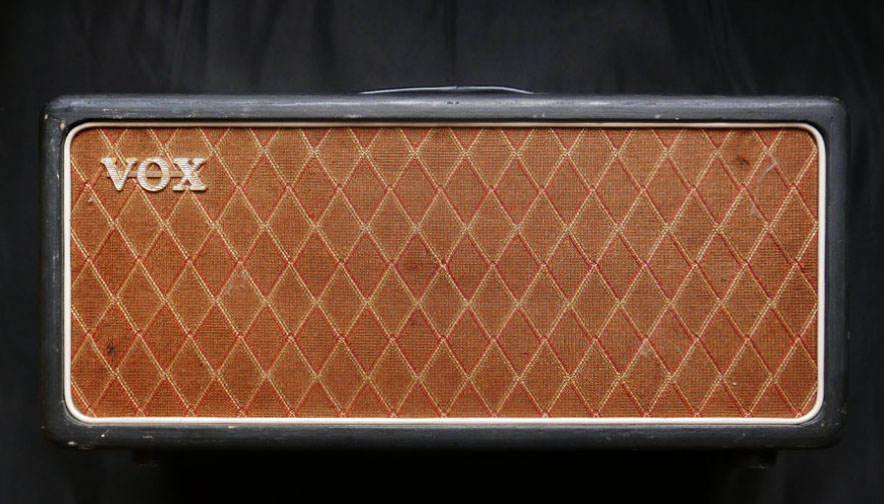
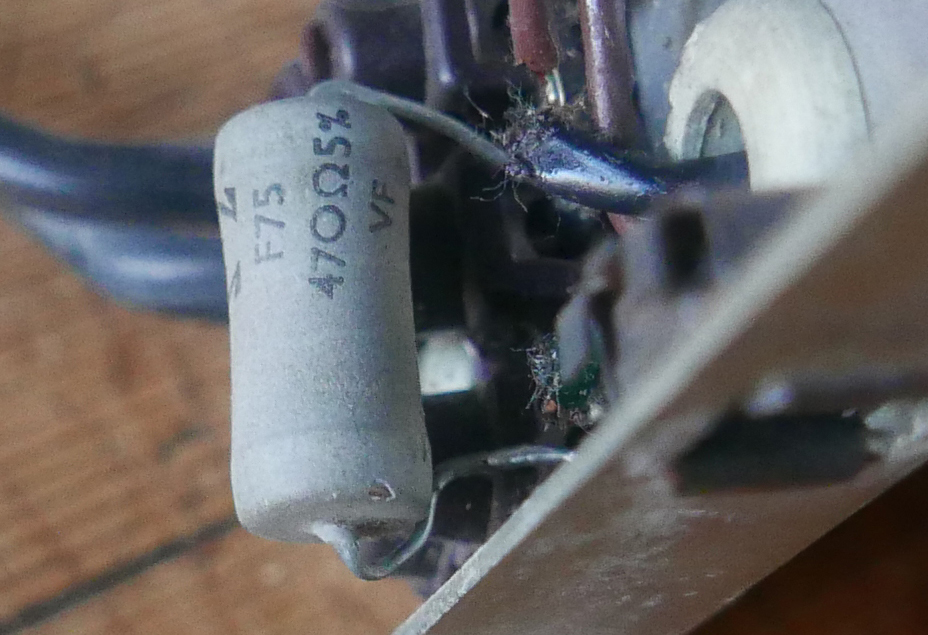
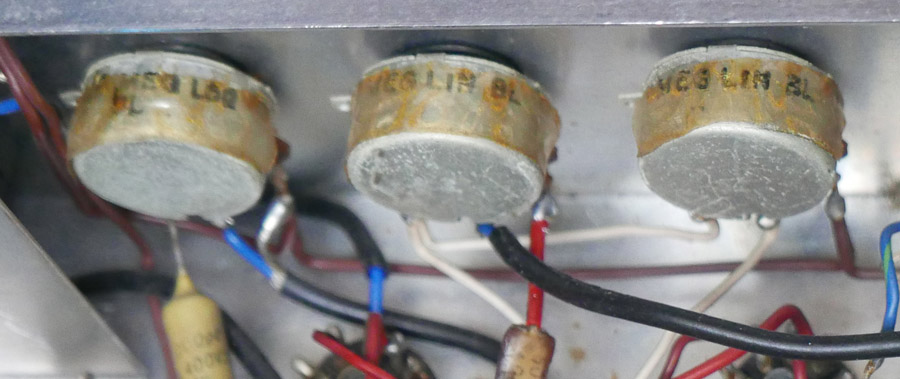
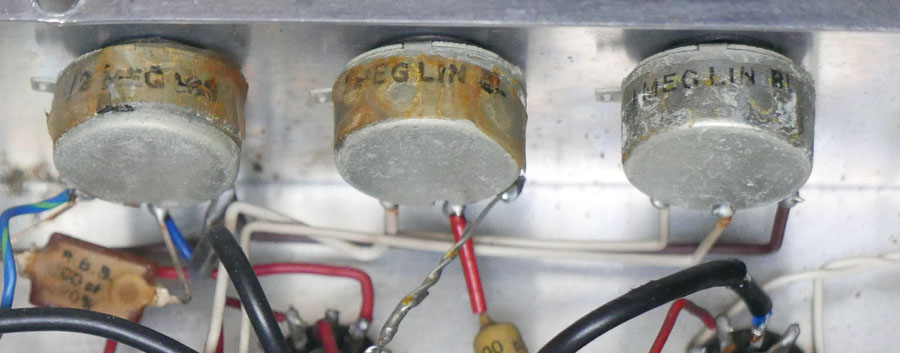
Some shots of AC50 serial number 1349. The pots in the preamp all have the date code "BL" = February 1964 for their manufacture. Triumph evidently bought in large batches. The 470 ohm resistor at the speaker output block has "VF" = June 1964.
9th September
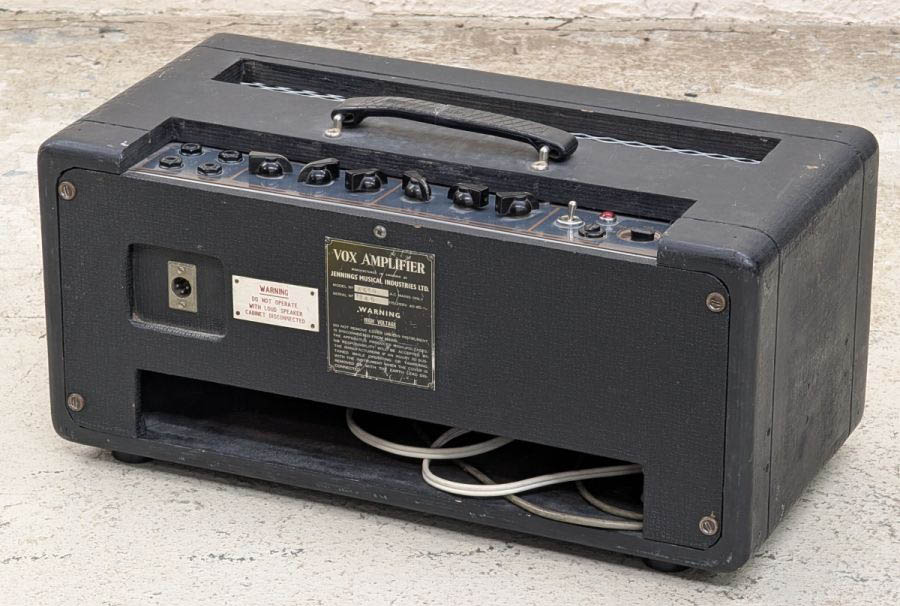
Recently come to light, serial number 1349, currently the second earliest large box AC50 Mark 2 to have surfaced. The arrangement of its back panel - single XLR socket from factory - is the same as that of numbers 1338, 1354, and 1360.
25th August
Entries for AC50 serial numbers 6478 and 6892 have now been included on this page. Thanks to Sebastian for pictures and info on 6892.
In company with serial numbers 4249 and 5372, number 6478 bears the shop plaque of Musikhaus Hummel, Frankfurt.
22nd August
Entries for six AC50s with serial numbers in the 5000s have been created / updated: 5206, 5227, 5372, 5529, 5753, and 5829.
21st August
Entries have been created for a further eight AC50s with serial numbers in the 6000s: 6012, 6033, 6156, 6331, 6671, 6788, 6815, and 6839. Pictures of 6815 and 6839 to follow.
20th August
Text entries have been created for six more AC50s with serial numbers in the 7000s: 7111, 7125, 7394, 7404, 7506, and 7749. All are currently in Europe (and were probably exported there early on). Pictures of 7404 and 7749 to come.
19th August
Text entries have been created for four AC50s with serial numbers in the 8000s: 8037, 8132, 8199, and 8210. All are currently in Europe (and were probably exported there early on). Pictures to follow shortly.
17th August
Well, having just said that serial number 3250 was the only amp that had materialised so far with a Mark 2 preamp and Mark 3 power section, what should turn up? Of course, a set of pictures showing that serial number 3256 was also sent out in this way from factory.
JMI was evidently pulling out all stops to meet the demand from America. Numbers 3250 and 3256, along with 3260, 3364 and 3384, were presumably part of a small batch of non-standard builds assembled for this purpose. A new section has been added for these amps here.
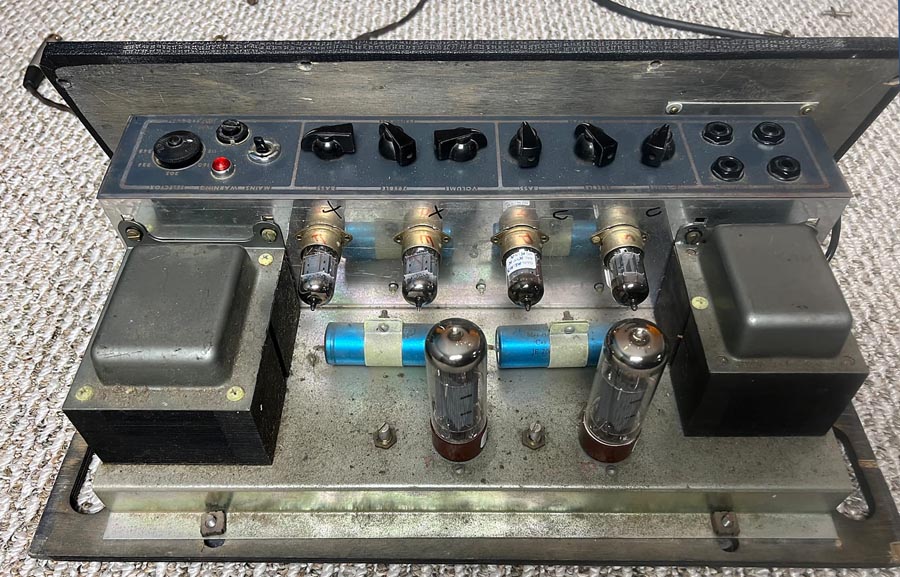
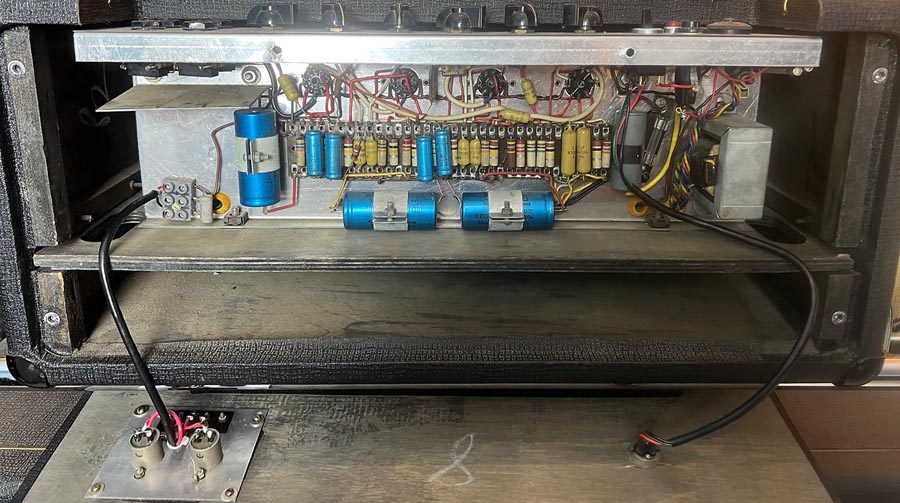
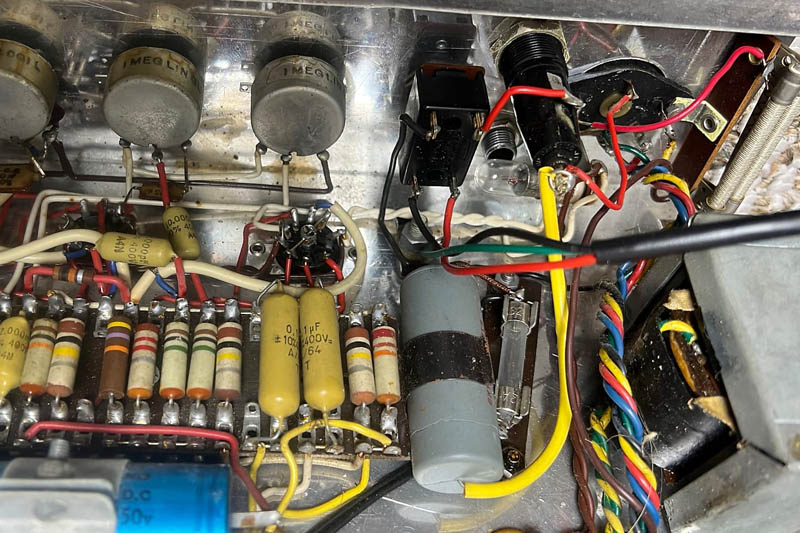
AC50 serial number 3256. In the preamp, the large grey Radiospares capacitor fitted by JMI to amps earmarked for export to the USA, and up by the voltage selector, the surgistor - a sort of surrogate brimistor - fitted by Thomas Organ.
16th August
AC50 serial number 3250, an interesting one. Its power section follows the Mark 3 circuit diagram, the preamp the Mark 2 (as assembled by Triumph). In the latter, the white coaxial cable and main coupling capacitors (date code "A4N") remain, along with most of the original resistors. The signal caps were replaced at some point though with later Mullards, 1966 and 1970 date codes. So far no other AC50 has been identified with preamp and power section of these different generations.
Thanks to Adam for the pictures - more to follow.
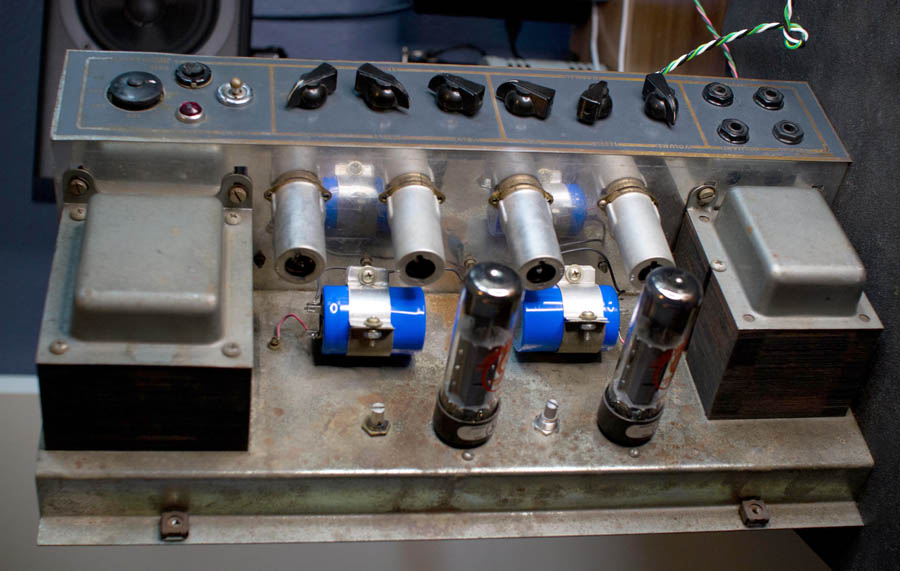
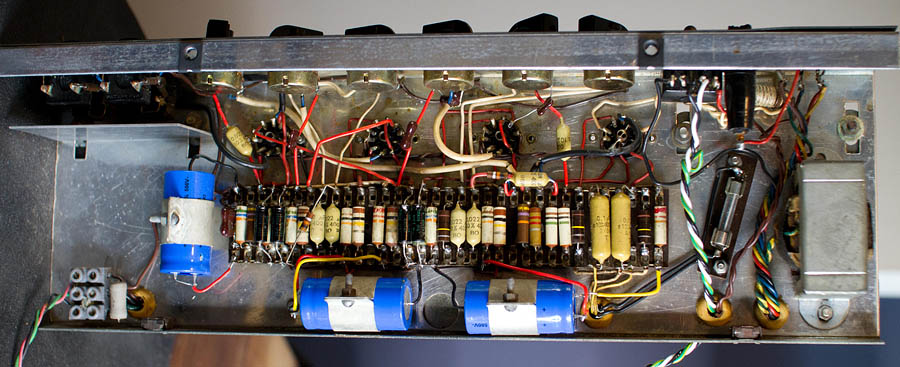
AC50 serial number 3250
15th August
Some shots of AC50 serial number 8113, late 1967, long in Scandinavia, have been added on this page.
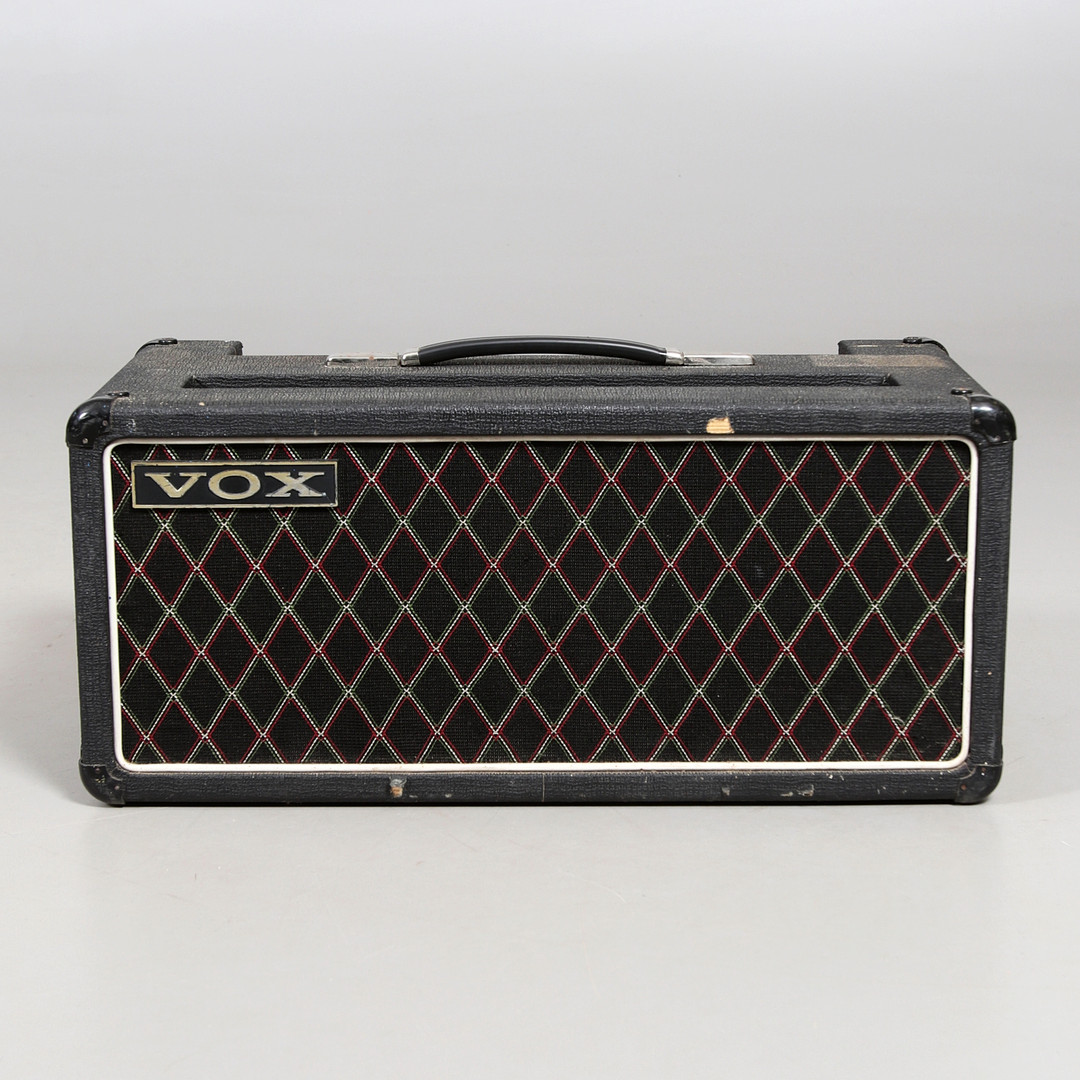
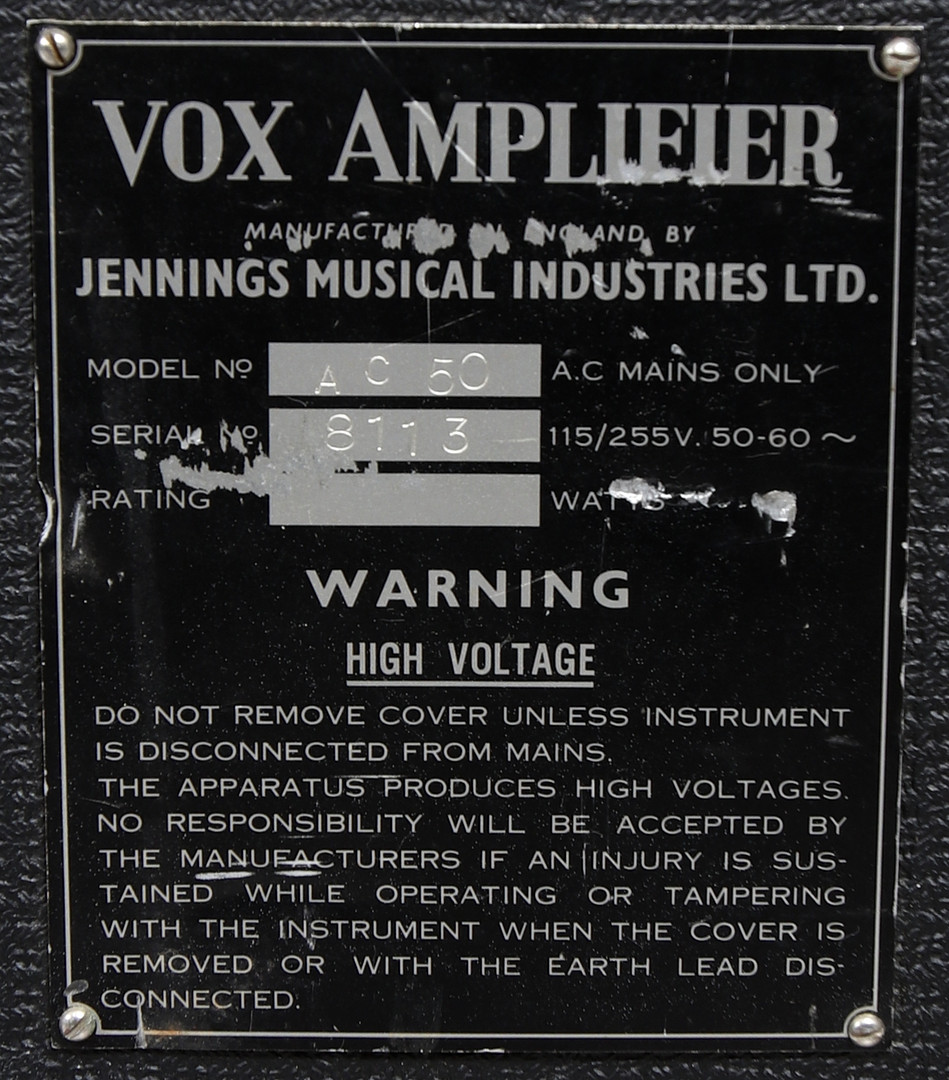
AC50 serial number 8113.
12th August
Some updates coming shortly.
7th July
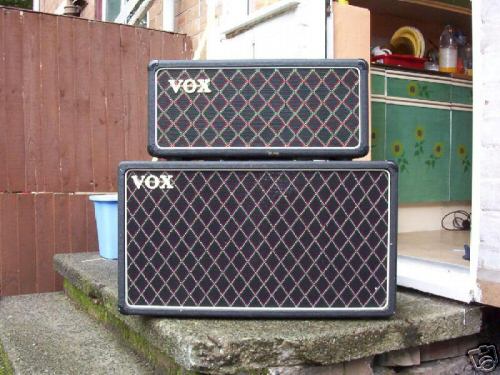
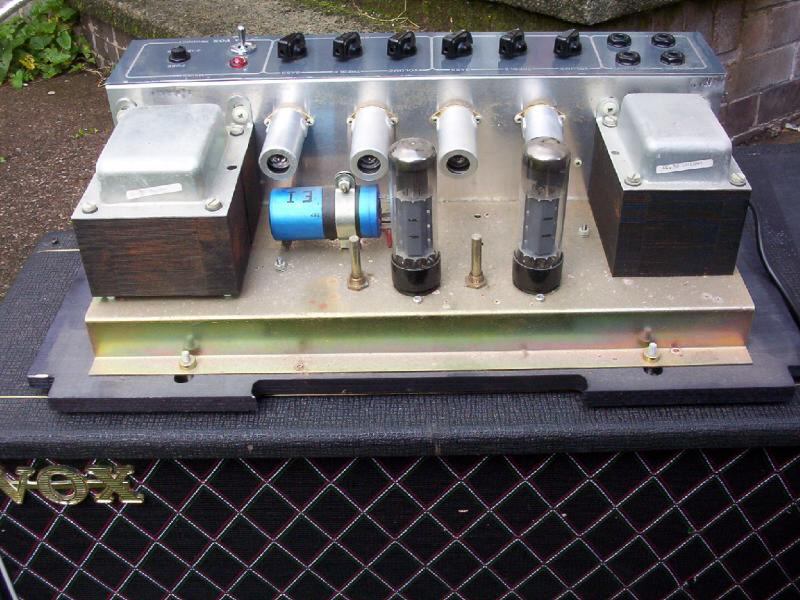
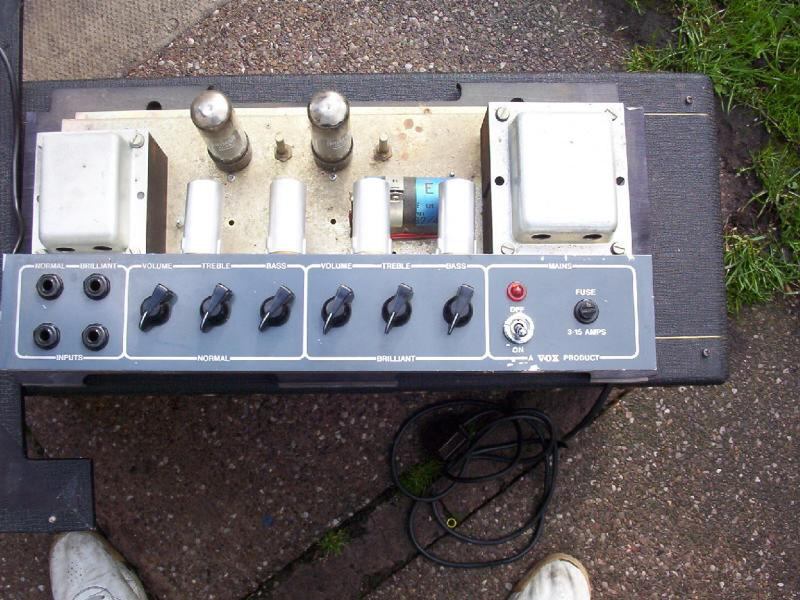
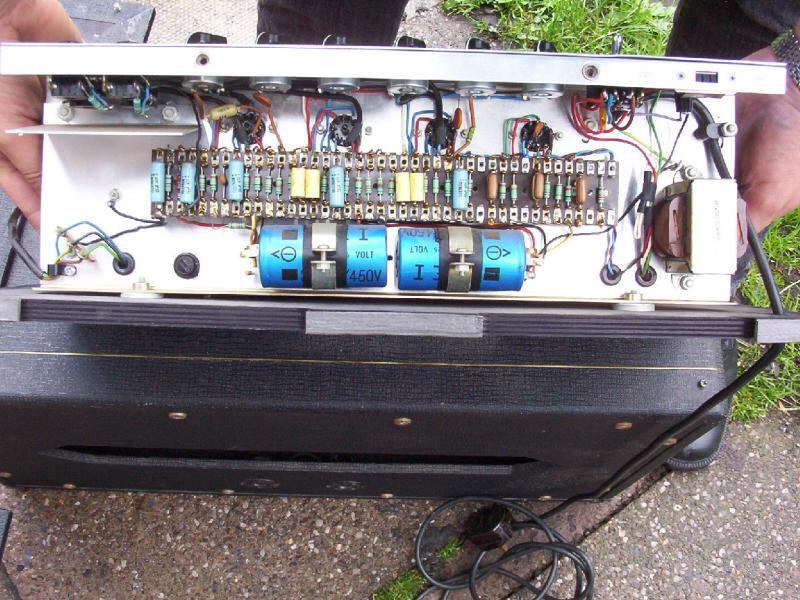
Early 1980s, a small run of AC50s issued by Rose Morris with a miniature speaker cabinet (just room for 2 x 12" drivers).
1st July
A further thin-edged two-input AC50, known for a little while, now back in good original order. Further pics to be added on this page shortly.


Serial number unknown.
30th May
Thanks to Jeremy, pictures of AC50 serial number 2591, valve rectified, produced by Burndept for JMI in late 1964 / early 1965, have been added here.
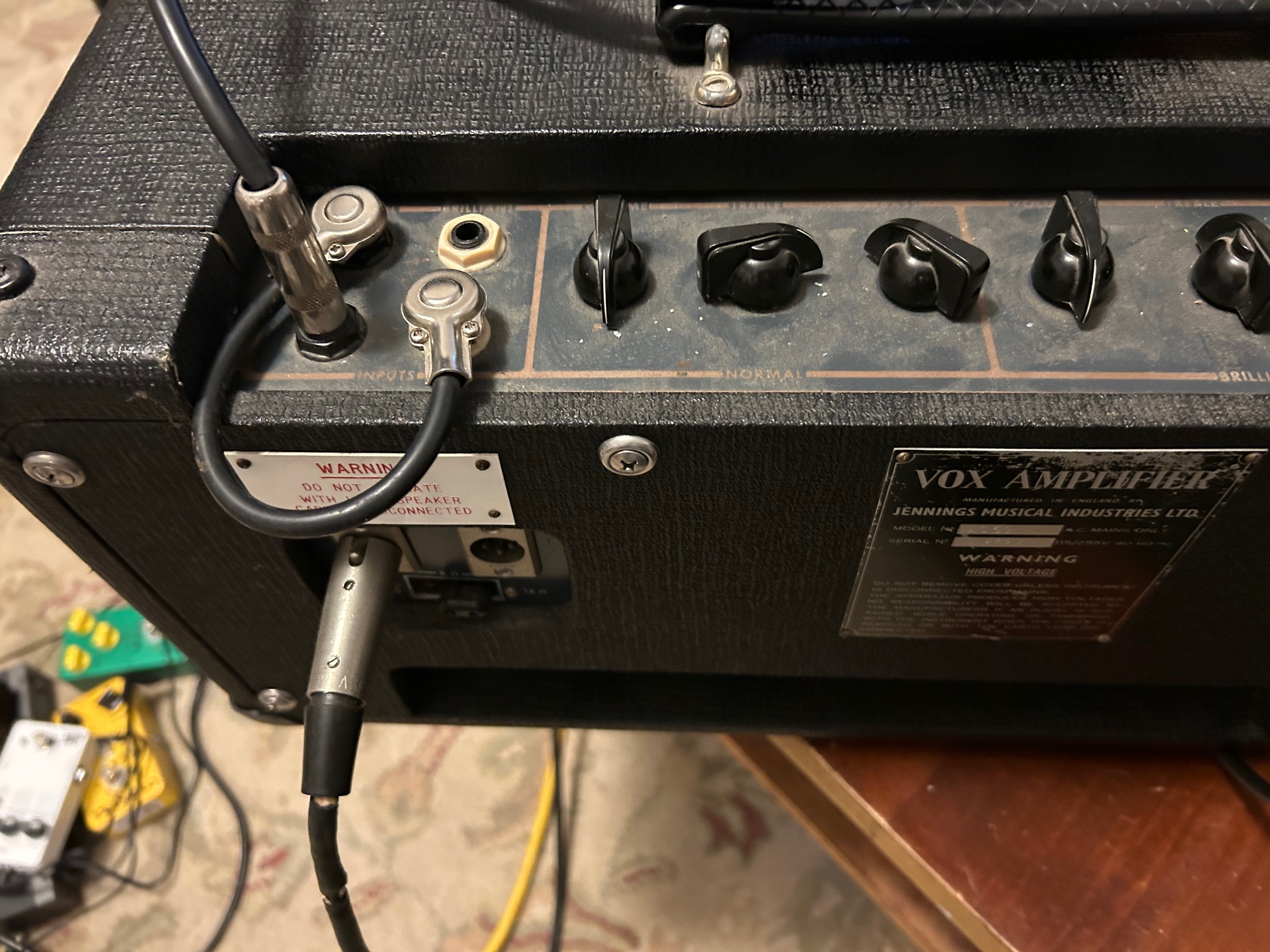
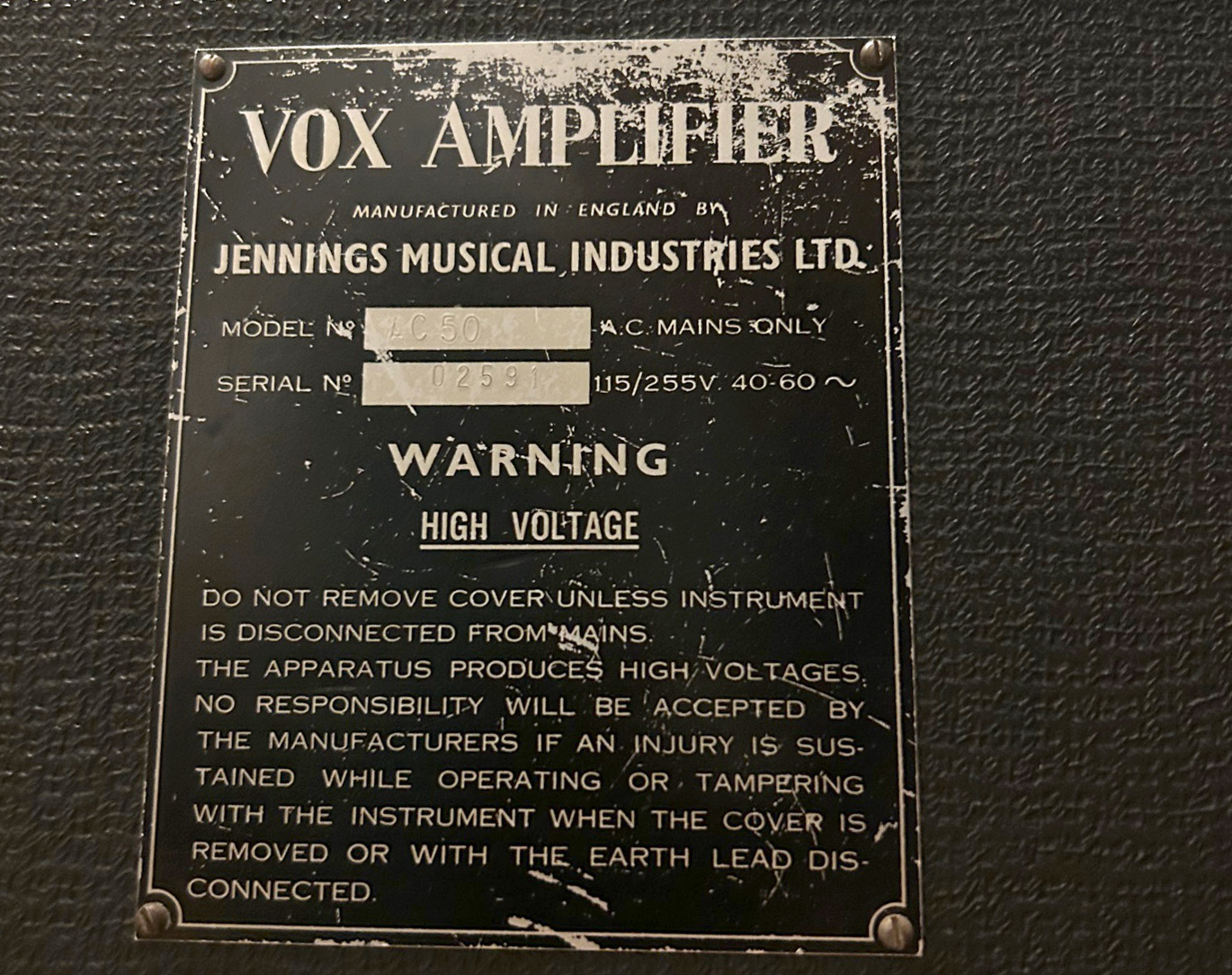
AC50 serial number 2591.
21st May
Text entries have been added for a further six large-box AC50s: 3740, 3745, 4477, 4747, 4821, and 4871. Number 4747 however is actually in an AC100 box. Box and chassis have shop stickers of Servaas in The Hague.
13th April
There is now an entry for AC50 serial number 5438 - thanks to Martin for the pictures.

23rd March
Thanks to Volker, pictures of AC50 serial number 5299 have been added here.


AC50 serial number 5299.
16th March
Thanks to Jozef, there is now an entry for AC50 Foundation Bass serial number 3489 here.


AC50 serial number 3489.
9th March
Entries for two superb late single channel diamond-input AC50s have been added on this page: serial numbers 1305 and 1331.
1st March
Entries for a further ten AC50s with serial numbers in the 3000s have been added to this page: 3014, 3139, 3248, 3382, 3543, 3579, 3613, 3666, 3840, and 3999. More to come shortly.
28th February
Entries for eight more AC50s with serial numbers in the 4000s have been added to the page on the range: 4060, 4079, 4172, 4213, 4290, 4334, 4412, and 4574. More to come shortly.
25th February
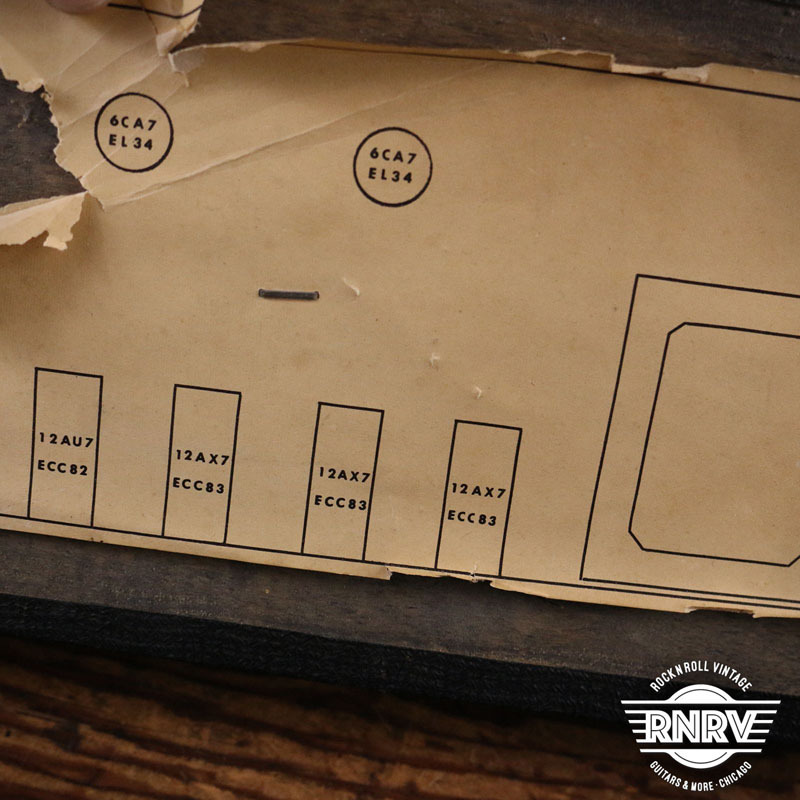
Currently on sale on Reverb in the USA, an AC50 amplifier section with a printed schema of the chassis - presumably drawn up and added by Thomas Organ - stapled to the underside of the slider board.
AC50 serial number 3740.
18th February (2)
An afterthought in relation to the entry below: could those 2 x 15s have been try-outs of the type issued to The Beatles, specifically John and George, for their concerts in Stockholm in July 1964: i.e. of the same dimensions as a Super Twin AC50 speaker cabinet, but with 2 x 15s instead of the 2 x 12" and Midax horn? An outside chance perhaps. But the seller, who does seem to have known his Vox gear, did note "custom built".
18th February
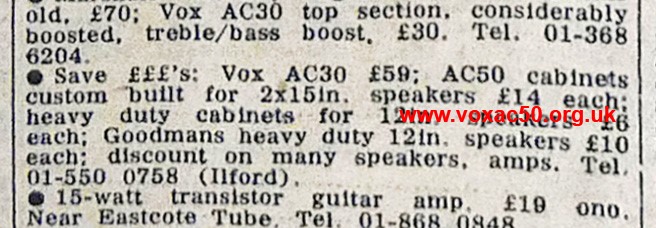
A slightly bendy shot of an advert in "Exchange and Mart" magazine, October 1968 - tall 2 x 15" AC50 bass cabinets without speakers. The seller, based in Ilford (East London), had numbers of these for sale through to mid 1969, presumably having picked them up at the Vox liquidation sale of September 1968. He and a seller in Hainault evidently bought in substantial amounts of surplus old stock.
That "Vox Sound Equipment Limited", which succeeded JMI in the late summer of '68, kept some of these cabs back for its own use, the model newly designated as the "T100", is clear from survivals. JMI had simply called them 2 x 15s.
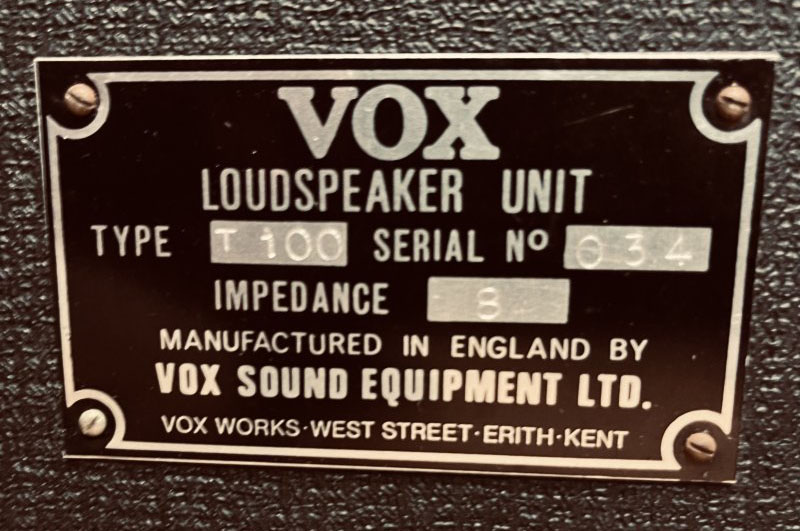
T100 serial number 034.
15th February
The interior of the case of AC50 serial number 1004, a tight fit for the chassis, as all these early cases were. Interior bottom to top: 5 1/4"; bottom to the underside of the screws for the handle: 5 1/8"; height of the chassis to the top of the EL34s (Mullards): 5". Tolerances therefore all round of 1/8".

Box of AC50 serial number 1004.
9th February
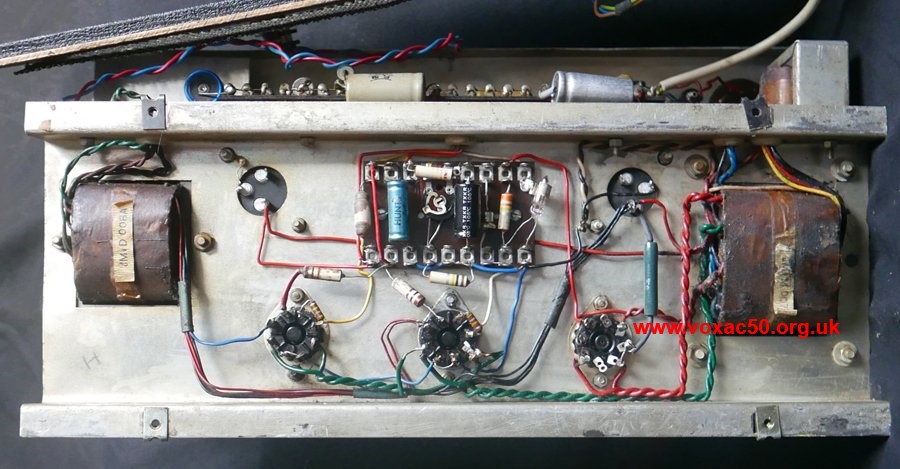
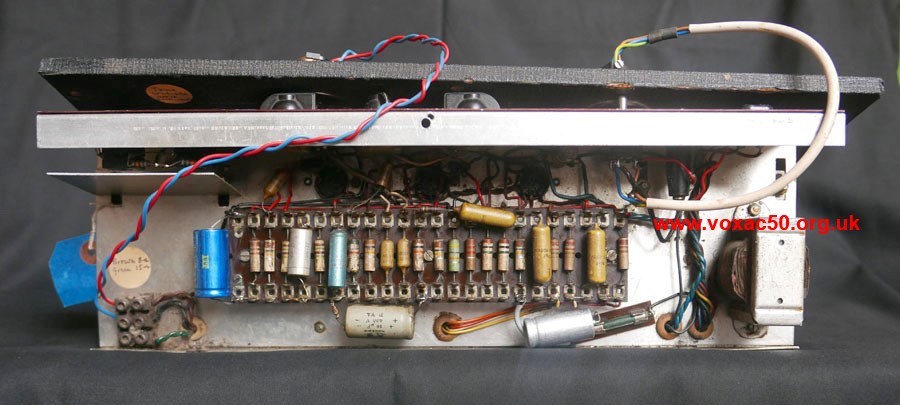
Some new shots of the late AC50 mark 1 (summer 1964) that came to light towards the end of last year - back now in full working order (it worked initially but was not happy). The EL34s are 1970s Japanese production, short enough to fit comfortably when the chassis is in the box. Height is extremely limited. Other types that fit are: Mullard XF1 to XF4; American-made large bottle 6CA7s; and 1970s Teslas. West and East German-made valves certainly do not fit. If you have one of these amps, keep clear of new production valves if at all possible.

27th January
An AC50 from later 1965 with two types of speaker socket escutcheon on its back panel, the original grey one apparently moved to occupy a new opening centre left on the back panel; and a black one from some earlier amp, originally with fixing holes for rectangular Cannon XLR sockets, positioned in the standard position beneath the warning plaque.

Serial number originally in the high 4000s / low 5000s, latest known component being a Hunts capacitors with "INS" = 37th week of 1965.

The wires from the terminal block: red = 8 ohms; green = common; yellow = 16 ohms.
9th January
The remaining original Hunts capacitor on the bias board of the early AC50 pictured a little way below - entries in early November - has the date code "HIT" = 23rd week of 1964 (early June) for its manufacture, a further indication that the amp was one of the last two-inputters to have been made, production moving to the the four-input variety in July and August at the very least, perhaps also part of June. So far as one can tell, Triumph made around 200-250 four-input AC50s. Some were sold in parallel with the new AC50 mark 2, so the serial numbers of the later amps are by no means consecutive.
8th January
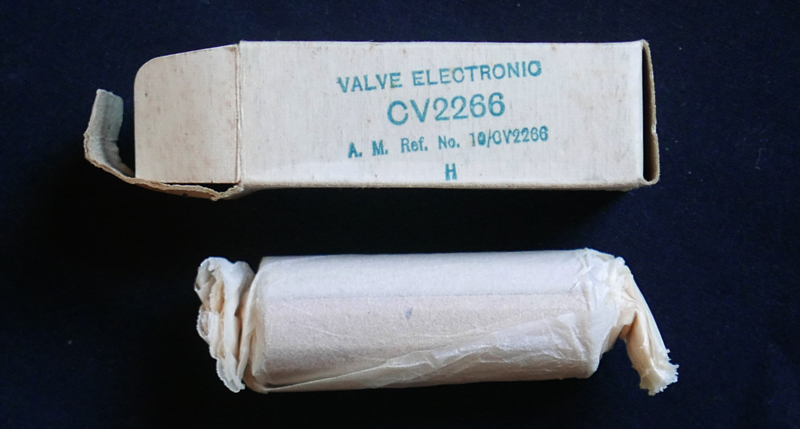
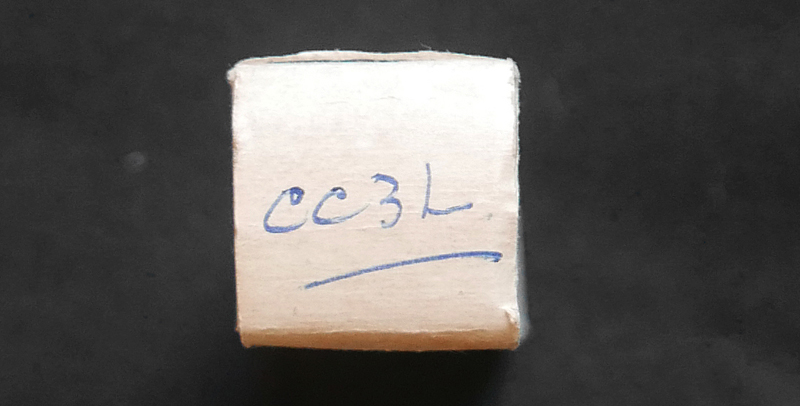
A new old stock CC3L neon valve of the type employed by Derek Underdown in the bias circuits of Jennings console organs (second half of the 1950s) and in the early AC50 Mark 1s (the two input variety). "CV2266" was its designation for military and official civil use. One occasionally finds "NT2" used as well.

2025
19th December
The bias board of AC50 serial number 8252, one of the last AC50s to have been sold by JMI. The red 8uf CCL capacitors have "C8" = March 1968 for their manufacture, and the maroon Hunts snubber cap has "TAN" = 49th week of 1967. JMI ceased trading in late April '68.

AC50 serial number 8252.
8th December
A further quirk of the early AC50 Mark 1 discussed recently: two screw holes on the upper edge of the back panel with corresponding cage nuts (2BA) on the preamp lip. The holes are original to the board. There were no others. Almost all production amps have only one screw on the upper edge of the panel, generally dead centre, self tapping, and no cage nut on the preamp lip.
The only real parallel for the back panel of this amp comes in the shape of the amps issued to The Beatles in late December 1963.
JMI were evidently extra cautious early on - perhaps because the transformers were Wodens and had no fixings on their shrouds for the preamp upright? See the entry for the 5th December, below.

Rear of George's amp, Olympia, late January 1964.

The new page on the amp can be found here.
6th December
Posted yesterday on the updates page of the Vox AC30 website, one of the last glimpses of the AC30s used by the Beatles in later 1963 - Paris Theatre (London), 18th December, 1963. A few days later John and George's new AC50s arrived along with Paul's AC80/100.

18th December, 1963.
Most of the shots on the web that purport to be of the concert at The Gaumont Cinema, Bradford, 21st December, are actually of the show at The Regal, Cambridge, in November.
5th December
The Woden transformers in the amp pictured in yesterday's entry are likely to have been part of a batch ordered by JMI somewhere around October '63, the date codes of the units in view being "LU" = November 1963. At least one amp will have been assembled with others from this batch - the "model" sent by JMI to Triumph to be copied for production runs. This was later purchased by Graham, the "chassis beater" at Triumph. It expired on stage one evening at the Shepherd's Bush Empire.
Whether the two amps consigned to The Beatles in December 1963 had Wodens is not known. The strongest sense - for the time being at any rate - is that they were simply among the first to have been assembled by Triumph (transformers sourced by Triumph, not JMI). All will become clear in due course however.
That the amp pictured below was prepared (in late 1963 or early 1964) for use beyond the walls of Dartford Road is highly unlikely, as has been mentioned. No further instances of Wodens in early AC50s (Mark 1s) have so far come to light.

AC50 mains transformer, part number 73631, date code "LU" = November 1963. The pattern of holes around the cut-out for the output transformer shows that the chassis was made specifically for Wodens, not the type of transformer later used by Triumph.
As the shrouds of Woden transformers did not have secondary fixing points ("ears") for the preamp upright, a rather bodged aluminium bracket was made up. Westrex fitted the Wodens used in AC80/100s with a small iron bracket, a reasonably tidy solution. Without support at transformer level, the preamp upright would be unduly fragile.

AC80/100, Woden mains transformer, part number 72191, date code "MU" = December 1963.
In late 1964, JMI came back to Woden for the short initial runs of AC50s produced by Burndept. These later transformers (date codes from August 1964 to February 1965) have plain metal shrouds, much as on those used for the AC30s and AC80/100s of the time.
4th December
A page has now been started on the AC50 Mark 1 that was probably sold incomplete at one of the JMI liquidation sales in late 1967 and 1968.

29th November
The page on Dallas-made AC50s is currently being expanded with further notes on and entries for early amps: serial numbers 7503D5090 and 7503D5110 (both March 1975); 75065124 and 75065140 (both June 1975); and thanks to Danny, a superb clean amp from the second quarter of '75 serial number unknown.
A page on the Dallas-made AC30s, which were put into production a good few months before the AC50s were set in motion, can be found on the Vox AC30 website.
28th November
AC50 output transformer, part 9: - the primary and common unwound. The common wire is of the same gauge as that of the secondary and has the same number of turns (53 in total).
The primary has around 1800 turns in total.
The diameter of the wire used for the common and secondary, 0.0625", is five times the diameter of the wire used for the primary, 0.0125".

The primary unwound completely, its end soldered to the red flying lead for the plate of the EL34 closest to the transformer.

The common winding, insulated from the primary by two layers of varnished paper, the black carbon track of the arcing visible along the lower edge. The black flying leads are soldered to the two ends of the common, one for a connection to ground on the primary side, the other attaching to the common lead for the secondary side (see the entry below for 23rd November).
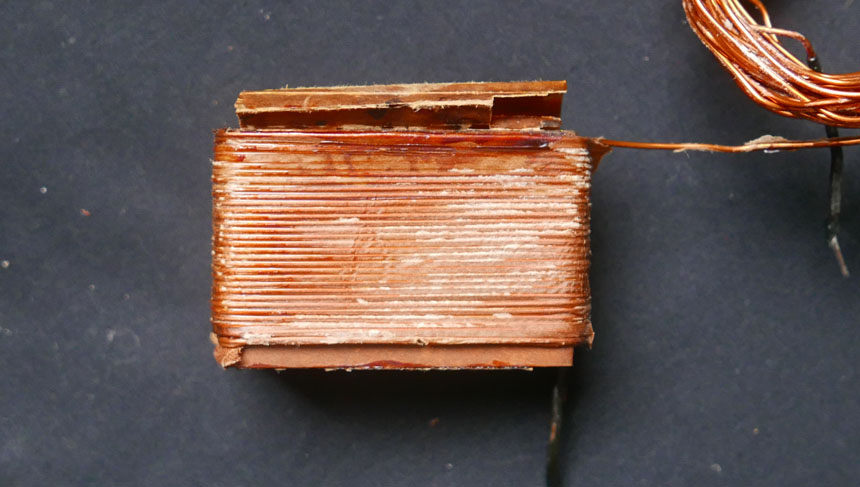
The uppermost layer of the common unwound.

The paxolin former, measuring 2 3/4" long x 1 7/8" wide x 1 3/8" tall. The flap is part of the outer wrap.
27th November
AC50 output transformer, part 8: - close to the beginning of the primary winding, a carbon track caused by arcing, likely to have been the root cause of failure.

26th November
AC50 output transformer, part 7: - the primary unwound to the point where the flying lead for the HT (B+) is soldered on. The connection was covered in thin yellow polyester film electrical tape, thicker cloth tape over the top.
As expected, during the unwinding of the tenth layer the primary wire separated again at the point where the corrosion had set in.

The flying lead for the HT soldered on.
25th November (2)
The diameter of the wire used for the primary winding of the AC50 OT pictured below is 0.0125" = 0.31mm.
25th November
AC50 output transformer, part 6: - nine layers down into the primary, i.e. not too far from the middle of the winding, corrosion, by the look of things extending down at least one more layer:
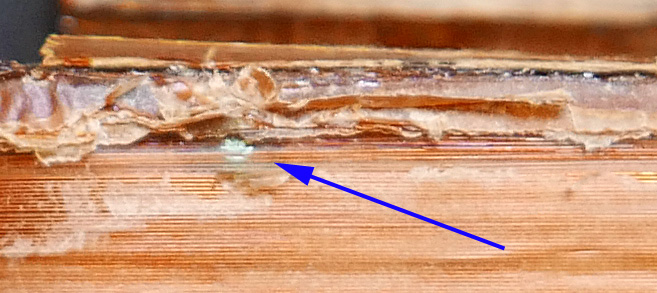
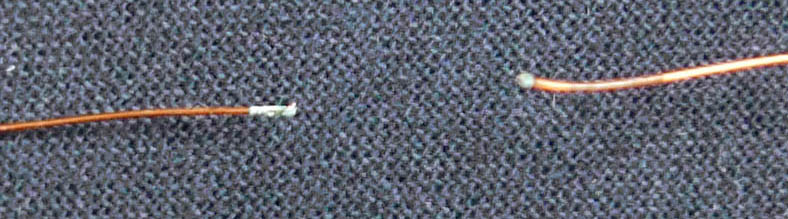
Separating during unwinding, the portion of the wire that lay over the corroded area.
24th November
AC50 output transformer, part 5: the wrap separating primary and secondary is thin paxolin/phenolic sheet (not varnished cardboard), extremely tough and quite stiff and springy. The uppermost winding in the primary (ie. the last to have been wound) is for the plate of the EL34 furthest from the transformer, its flying lead being blue.
NOTES: the end of the secondary and the end of its flying lead were placed together, tightly wrapped in fine wire, and then soldered (second pic in yesterday's entry). The 8 ohm tap appears to have 27 and a bit turns - this to be confirmed.

The paxolin/phenolic wrap unwound and the start of the uppermost winding (blue flying lead).
23rd November
AC50 output transformer, part 4: the second layer of the secondary now unwound completely, revealing the thin paxolin/phenolic wrap [not varnished cardboard] separating primary and secondary. As can be seen, the end of the secondary is soldered to the end of another wire that forms the flying lead for the "common" or "earth". Insulation is varnished cloth tape. The wire that forms the flying lead then passes through the body of the core and out the other side.
The number of turns between the 16 ohm and 8 ohm taps given in the previous entry has been corrected - 26, not 27.

Paxolin/phenolic separator between secondary and primary (yet to be unwound). The end of the secondary tied to the end of the flying lead, the solder joint still insulated.

Insulation of the joint removed.

Right-hand side of the terminal block for the flying leads from the output transformer: top: 16 ohms (green); middle: common or earth (black); bottom: 8 ohms (brown). The leads on the left-hand side of the block, all renewed in this instance, go to the impedance selector and speaker sockets on the back board.
22nd November (2)
AC50 output transformer, part 3: the unwinding of the secondary. Wire is 1/16" in diameter. Layers are separated with a thin paper winding, overlapped generously, and varnished.
The green-shrouded wire is the 16 ohm tap; brown, tacked further down in the winding, is 8 ohms. There are 26 [not 27 as previous stated] turns between the 16 ohm and 8 ohm taps.
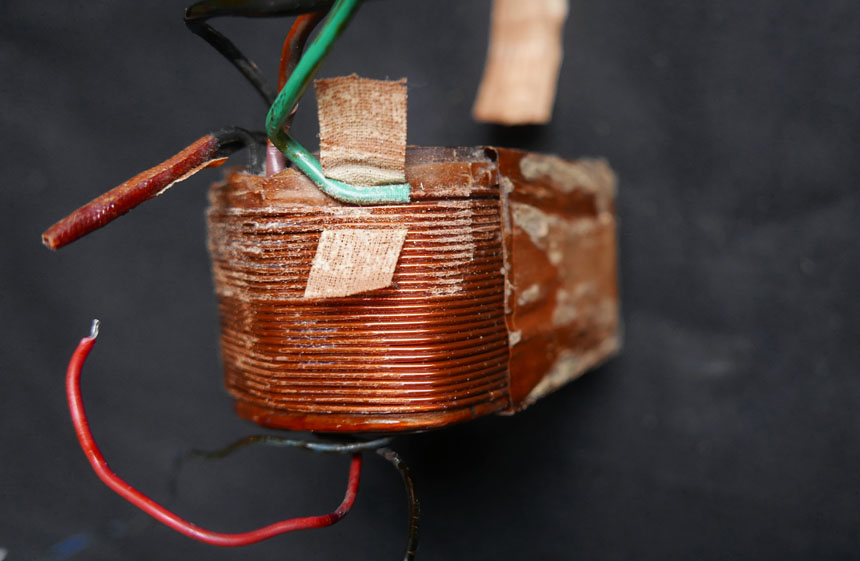
The end of the winding at the 16 ohm tap.

The first layer of wire unwound, the paper winding betweem the layers only part removed.

The 8 ohm tap tacked onto the secondary wiring.
22nd November
AC50 output transformer, part 2: the laminations and outer wrap removed. At left, the part of the core that dropped through the opening in the chassis plinth, all flying leads running underchassis.

Laminations removed, waxed paper wrap still in place.

The end of the core covered by the shroud. Varnish is heaviest here (to guard against contact with the metal).

The waxed paper wrap removed, snake-skin like. The wrap was varnished.

The outer windings exposed, small sections of adhesive cloth tape at points around the circumference, paper around the sides of the former and across the windings - see also the first pic, above.

The underchassis end of the core.
21st November
AC50 output transformer, part 1: a sort of work in progress: - the breaking down of the failed output transformer from AC50 serial number 3385, a Mark 3, mid 1965, chassis assembled for JMI by Burndept. No maker's marks are visible. The laminations are 0.014" thick. The failure that took place was pretty catastrophic, the primary now measuring around 500K ohms instead of around 100 ohms.
Burndept initially used Wodens (for Mark 2s) but moved over to this new supplier - name unknown at the moment - a few months later (Mark 3s).
Some notes on the transformers used by Triumph Electronics for the amps it made for JMI can be found on the updates page of the Vox AC100 website, entry for 20th November.


6th November
Front and top view of the Mark 1. Although the current plastic speaker socket is later, it may that the original was in fact something similar rather than a Cannon XLR (as suggested yesterday). The two holes that seem to line up with those on a Cannon socket look slightly tentative - no sign of the third. Something else may have been attempted in between.
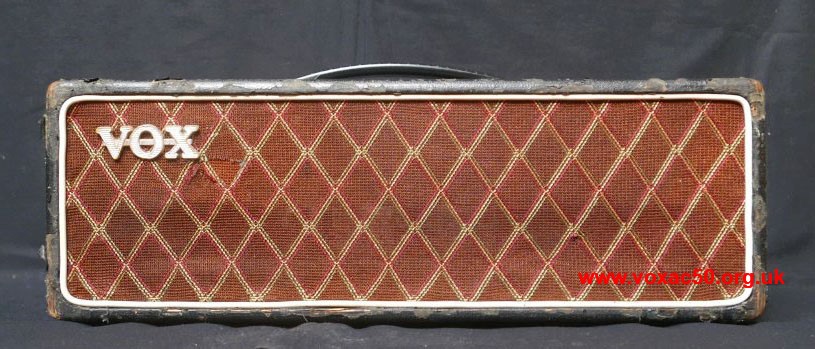
Grille cloth renewed.
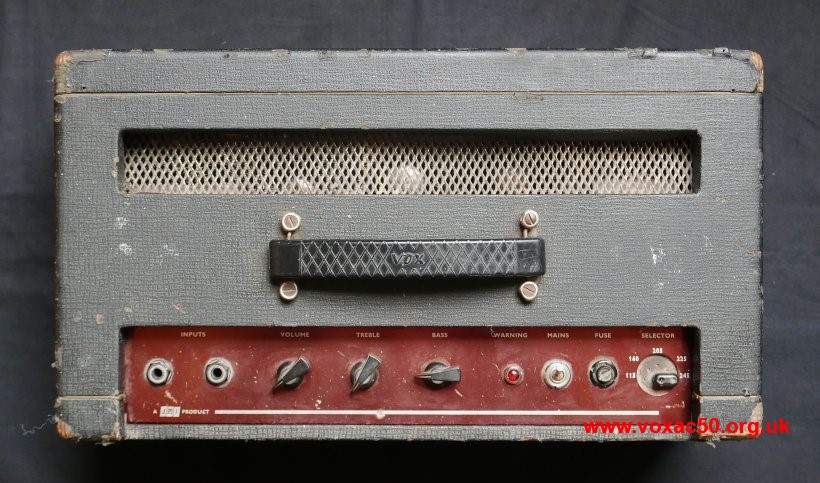

Later speaker socket unscrewed

Cannon XLR-3-13 speaker socket of serial number 1034.
5th November
Exteriors of the AC50 Mark 1. Some of the original brown grille cloth survived underneath the black Rose Morris cloth that had been added in the 1990s, but it was too far gone to save. The corner protectors that had also been added have now been removed.

Front cloth now renewed.

The Bulgin mains socket is original, the speaker socket was originally a circular Cannon XLR-3-13.
3rd November
Some initial shots of the chassis of the early AC50 Mark 1 that came to light last month (entry below for 12th October), a serial number probably originally somewhere in the range 1050-1000, ready for sale in late Spring 1964. Thanks to Chris.

The EL34s are Mullard XF4s from 1970 and 1976, one branded Tungsram. The GZ34 is Japanese-made, 1990s.

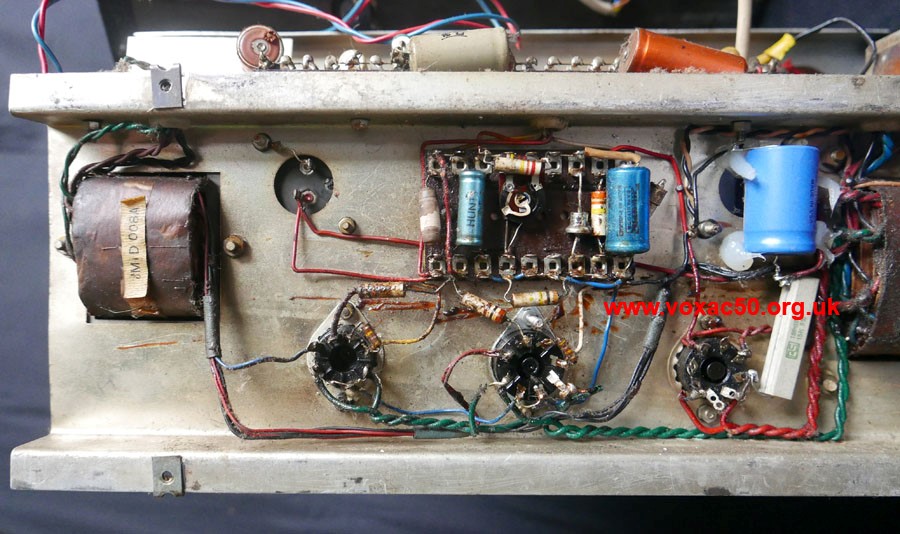
The work done in the 1990s will need to be tidied up.

The two original pots have the date code "BL" = February 1964 for their manufacture.
28th October
Thanks to Per, pictures of AC50 serial number 7115, exported to Sweden early on and still in superb condition, have been added to this page.


AC50 serial number 7115.
25th October
Serial numbers 2397 and 2398, fitted out very differently, one originally sold (by JMI) in the UK, the other to Europe. Number 2397 - already illustrated on this page - was used principally as a PA amplifier.
2397 is solid state rectified, probably produced by Triumph; 2398 valve rectified, produced by Burndept (Woden transformers).
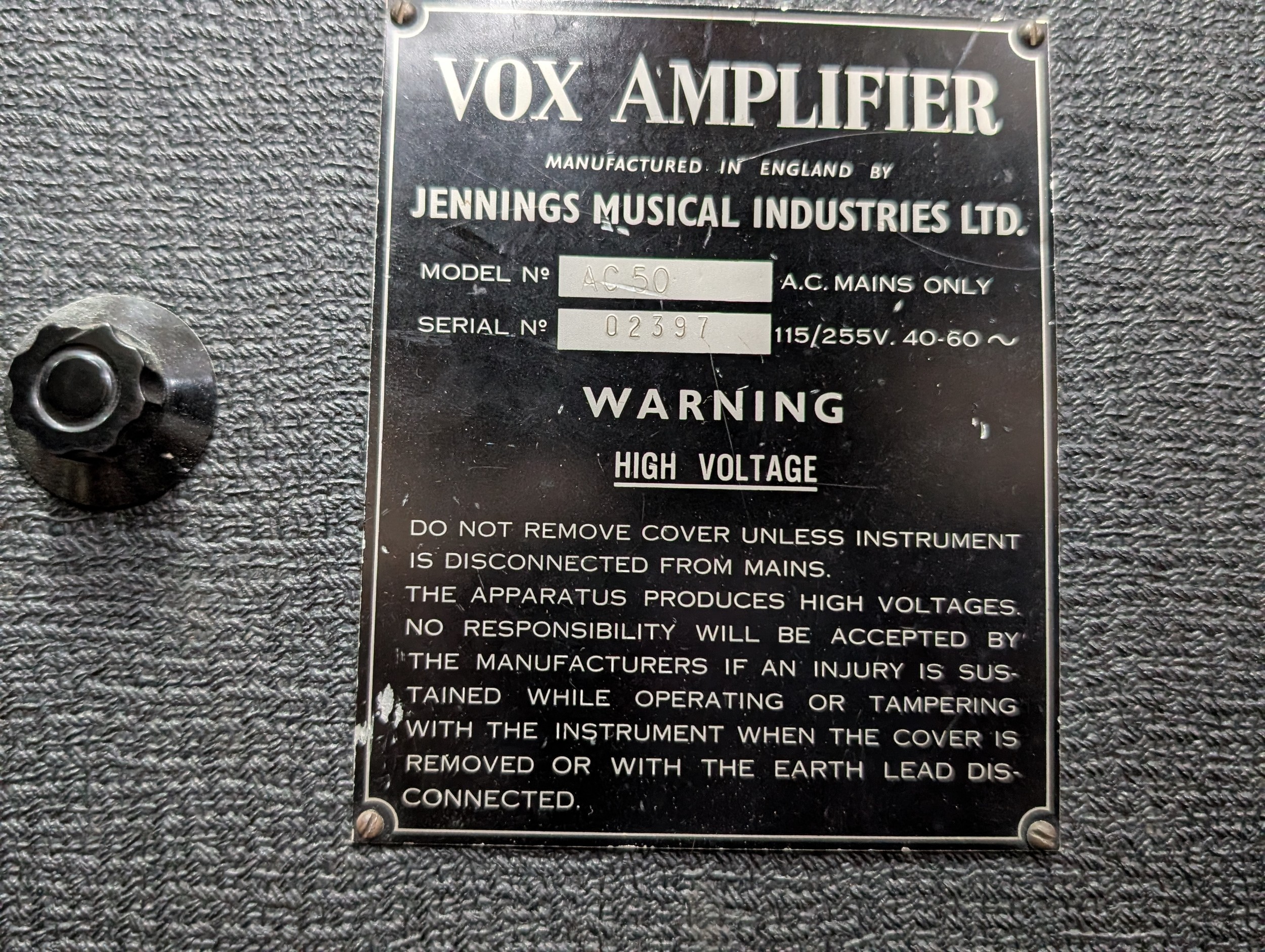
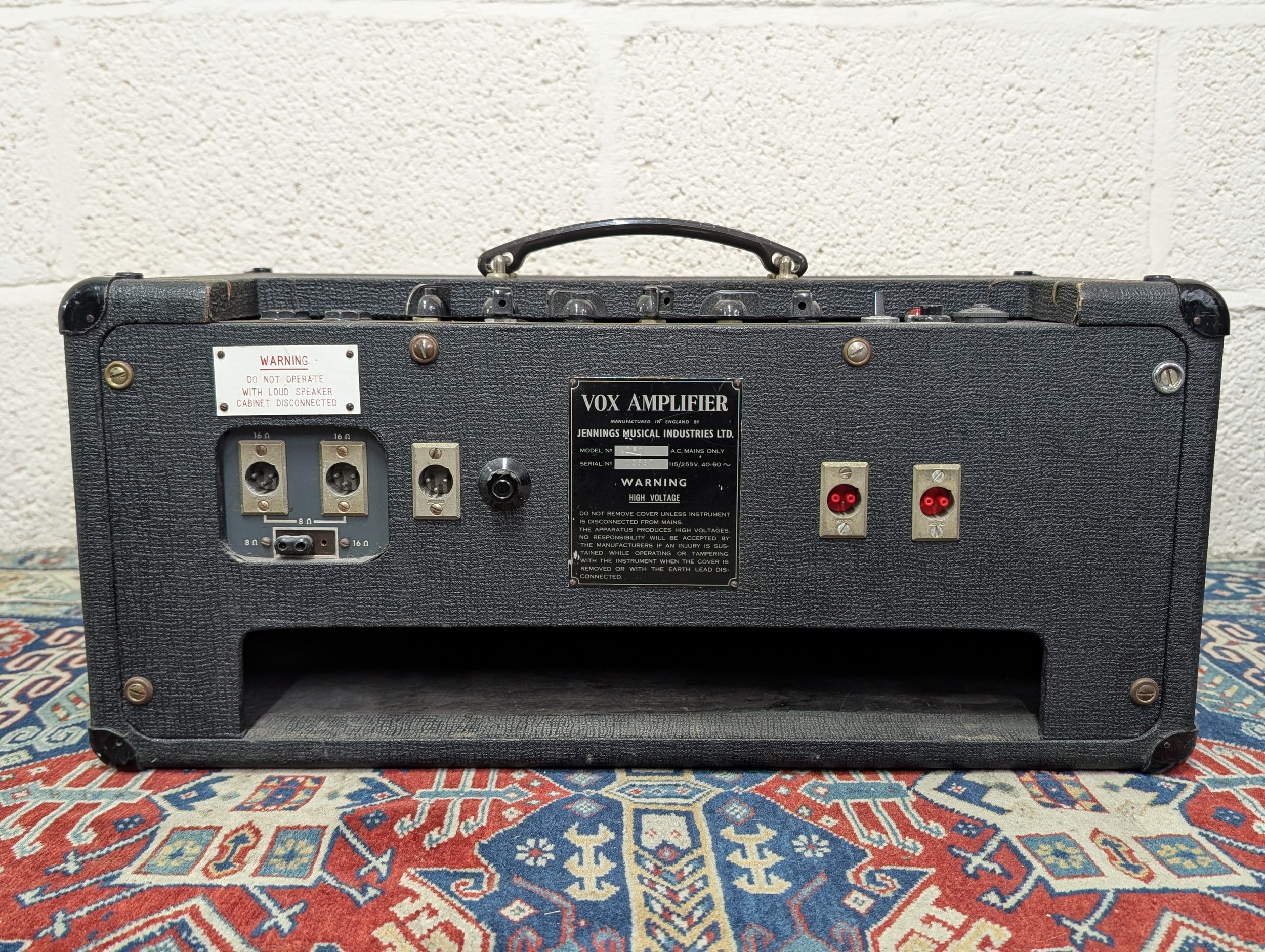
Serial number 2397. It is not clear why two Cannon power sockets were provided on the back panel.
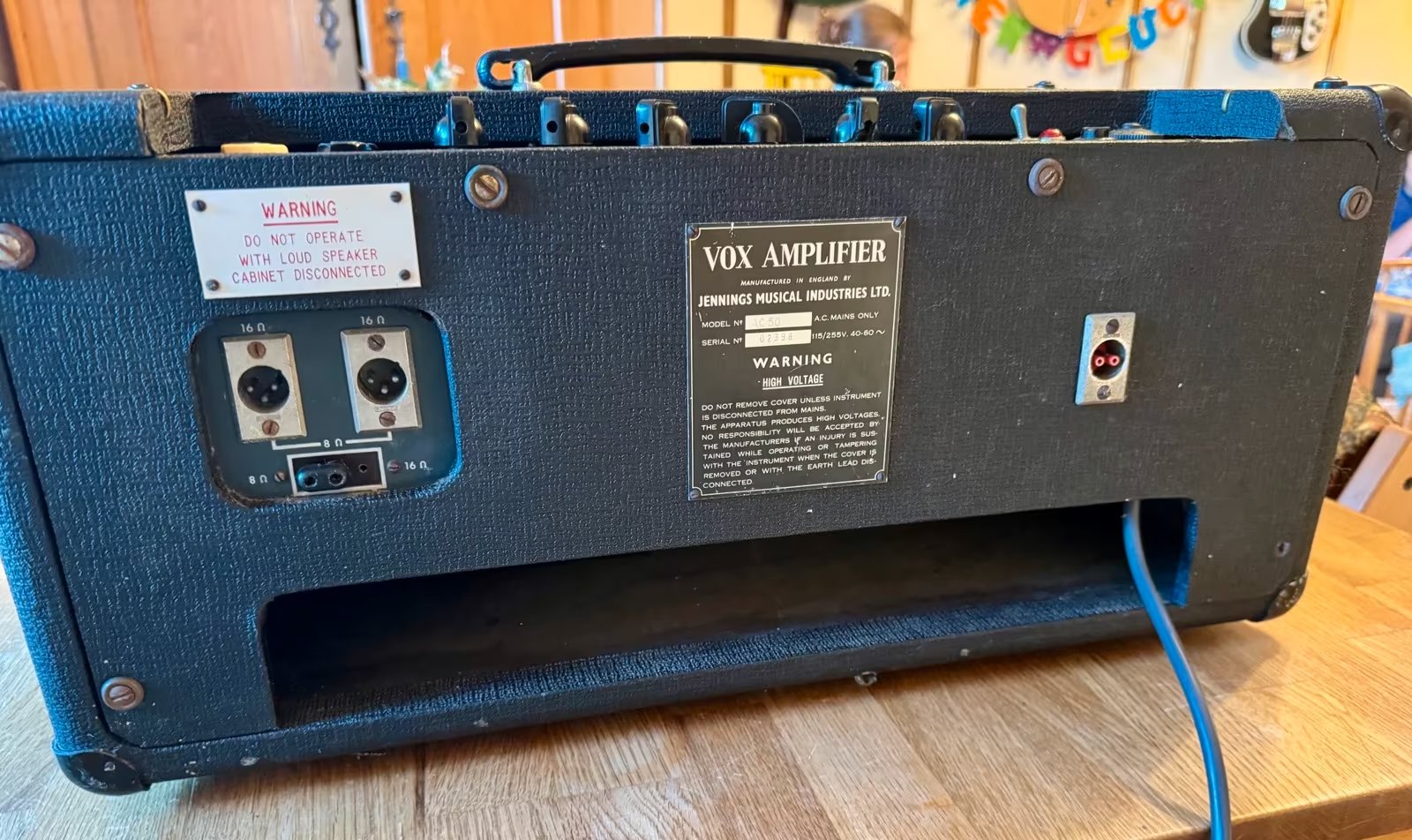
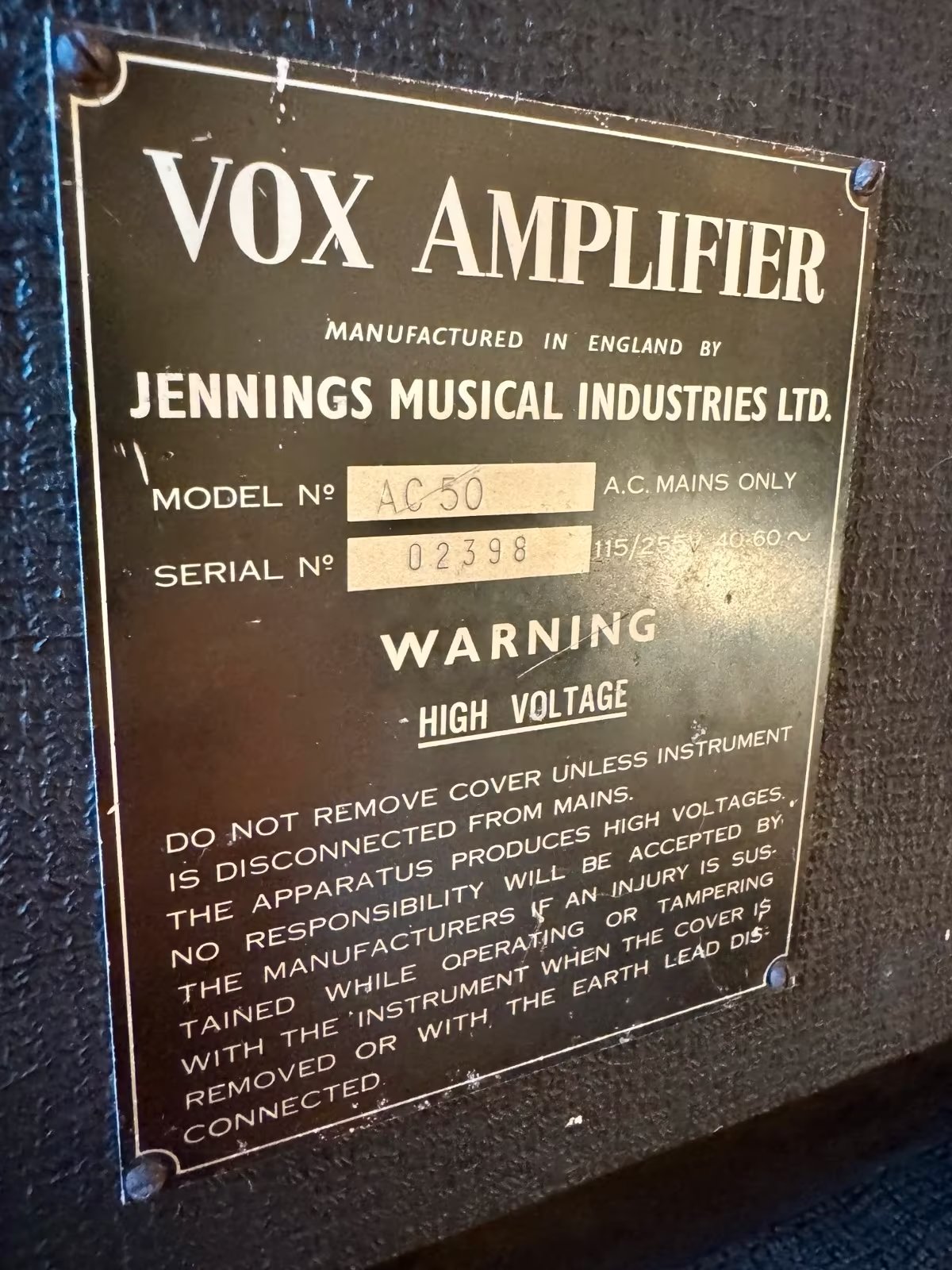
Serial number 2398.
12th October
Seen passing by a few days ago, an early AC50 amplifier section (Mark 1, two inputs, thin-edged box), serial number unknown, in company with a later T60 speaker cabinet. At some point probably in the 1980s or 1990s, the amp was given Rose Morris grille cloth and corner protectors at front. Small pictures for the time being, more to follow.


The speakers in the cabinet are Goodmans Power Range, 1967 or later.
11th October
Thanks to Brian, a shot of the power section of AC50 serial number 6860, a Triumph-made amp from 1966, signed off by Graham - eyelet tagboard, large Hunts suppressor capacitor across the rectifier diodes. A similar arrangement can be found in serial number 4007.
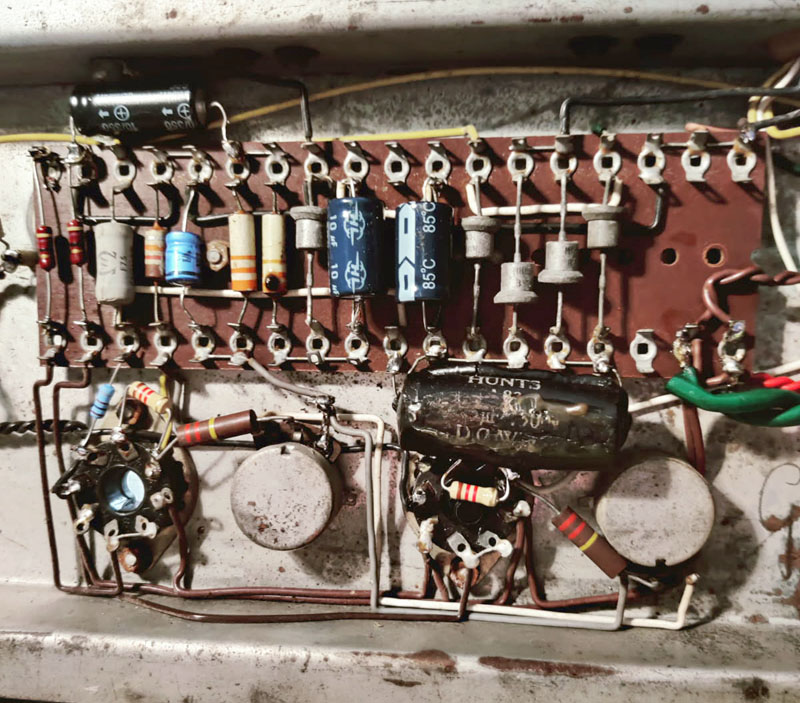
AC50 serial number 6860.
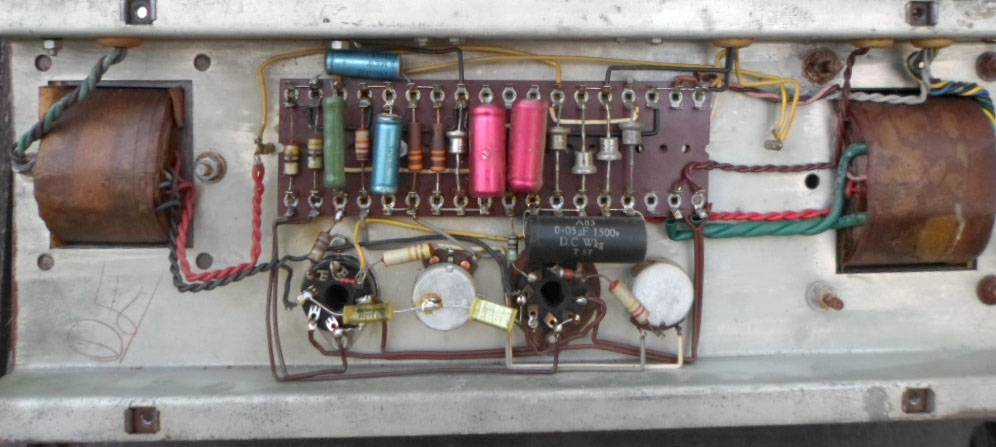
AC50 serial number 4007.
29th August
"Exchange and Mart", July 1965, an early AC50 Foundation Bass set for sale. The dimensions given are a little rough and ready, but mention of two inputs indicates the amp was a first generation AC50 Mark 1.

July 1965.
5th August
Around serial number 5500 a new style of red warning plaque comes in, WARNING in smaller letters, the lines of text underneath more widely spaced.

Serial number 5448.

Serial number 5532.
4th July
Thanks to Lasse, pictures of AC50 serial number 5522, early 1966, exported to Scandinavia early on, have been added here.


AC50 serial number 5522.
24th May
Six new entries for AC50s with serial numbers in the 5000s: numbers 5291, 5372, 5529, 5539, 5834, and 5987.
23rd May (2)
A further three entries in the 4000s: numbers 4397, 4571, and 4730.
23rd May
Five additions to the page on AC50s with serial numbers in the 4000s: numbers 4077, 4117, 4172, 4213, and 4375, select pictures of 4117, 4172 and 4213 to follow in due course. Further instances of amps in the 4000s to come.
22nd May
Four more entries have been added to the page on AC50s with serial numbers in the 3000s: serial numbers 3632, 3717, 3804, and 3850. From around numbers 3800 to 3900 JMI fitted plates headed "AMPLIFIER" rather than "VOX AMPLIFIER".
Just to record that the page now contains entries for around 100 amplifiers, i.e. 10% of the total made ready for sale by JMI in this serial number range. As for the other 90%.... Perhaps another 100 surviving? AC50s are hardy old things.
21st May
Entries for six AC50s with serial numbers in the 3000s have been added on this page: 3120, 3224, 3248, 3317, 3444, and 3559.
20th May
An entry now provided on this page for AC50 serial number 2317, part of a batch sent by JMI to Scandinavia; and pictures of number 2681 paired with a refurbished cab in recent years. Further batches of updates to follow shortly.
10th May
Two early Mark 2 chassis both in small boxes from factory, cathode bias resistors added later. The EL34s in serial number 1311 wee given a 50R resistor each, imitating the arrangement set out in the circuit diagram for the AC50 Mark 3 (OS/072, 47R resistors specified). The other amp, much modified, has 150R resistors with cathode bypass caps, the latter 1970s metallic green 32uf/150v TCC/Plesseys.
In both amps the fixed bias network is still in place and in circuit. The reason for the additions? To spare the valves. Standard bias in these amps (ie. from factory, not modified) was -34v.

Serial number 1311, early Mark 2 chassis.

Serial number unknown, also an early Mark 2 chassis.
25th March
A superb AC50 SDL - serial number 4709 - complete with original cables (with Amphenol connectors). Thanks to Arjan for the pictures.


AC50 serial number 4709.
9th March
AC50 Foundation Bass serial number 1379, an early large box amplifier section with a single Cannon socket mounted on a vinyl-covered block on the back panel.
The speaker cabinet had evidently been got at by woodworm at some point - disclosed perfectly properly by the seller - but looked generally to be solid and in good order otherwise.
Original cables and cover for the amplifier section were all present. Further pics are on this page.


4th March
Thanks to Andrew, pictures of AC50 serial number 3065, mid 1965, have now been added on this page.


AC50 serial number 3065
2nd March
Thanks to Sam, pictures of AC50 serial number 2685 have now been added on this page. The amp is likely to have been part of a batch sent to the USA by JMI in the early Spring of 1965.


AC50 serial number 2685, pictured with a V125 cabinet.
1st March
A couple of cabs with single-letter logos, the first from late 1964 (with Celestion T1088s), the second from early 1965 (with Fanes).


22nd January
Thanks to Christian, the serial number of the first MC50 illustrated on this page has now been corrected - 2666, NOT 2885 as originally stated. An entry for the amp has also been made - here - in the main guitar/bass amplifier sequence.
21st January
Thanks to Dan, pictures of AC50 serial number 5393, early 1966, can now be found on this page.

