UPDATES
Older blog / update entries are now here.
2019, January-April
11th April
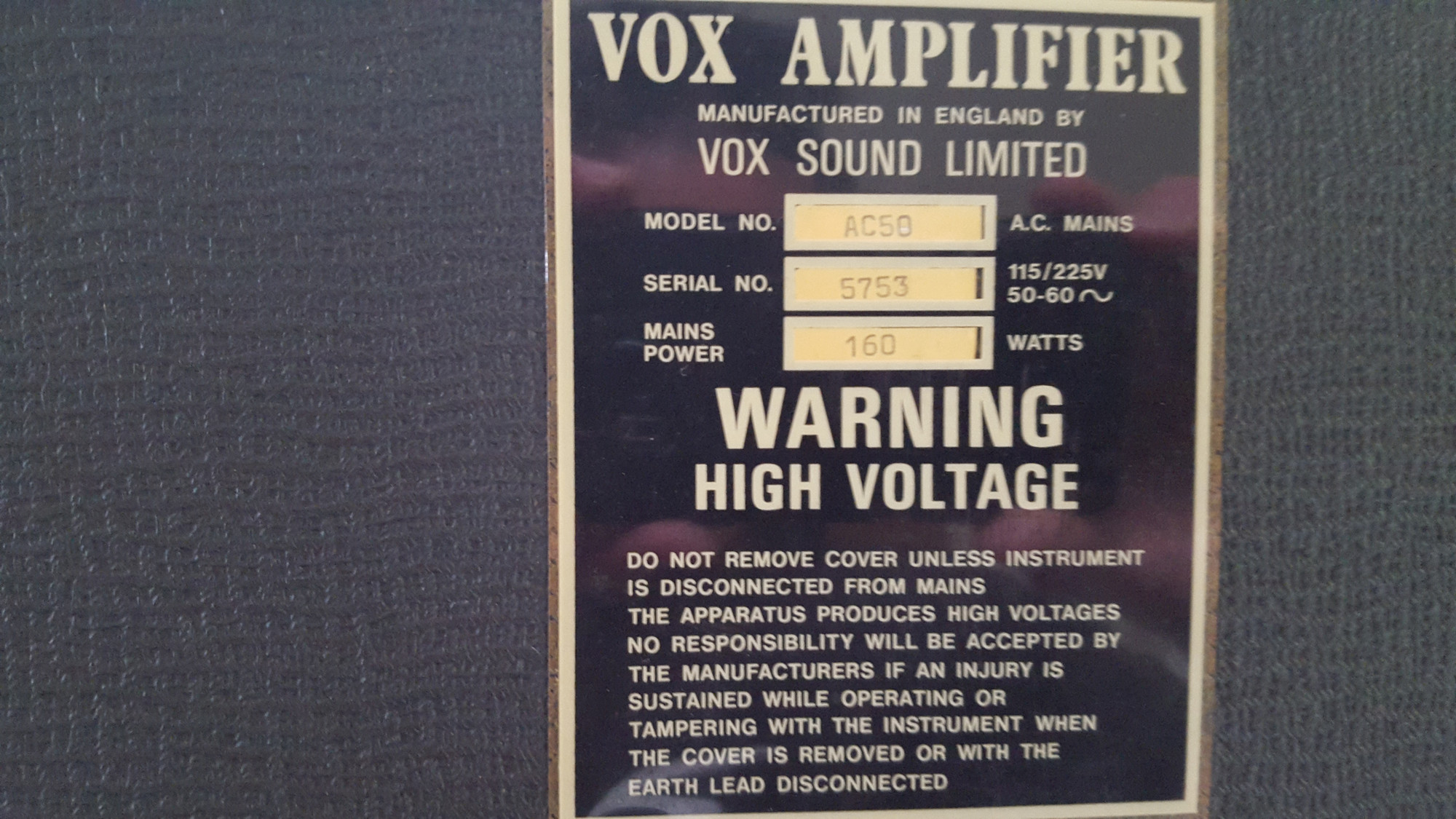
Picking up from the entry below, one can distinguish "Vox Sound Limited" AC50s made by "Dallas Musical Limited" from those made by "CBS-Arbiter" by the length of the serial numbers. Dallas amps have long numbers, all beginning "75" = 1975. Relatively few were produced. Some may have been assembled in the second half of '74:

Above the plate of a Dallas AC50 complete with original cover and warranty documentation.
AC50s sold by by CBS-Arbiter have four digit numbers beginning "5" = 1975, same style of plate as above (some differences in printing though), and "6" = 1976, new style plate:

10th April (2)
In February 1975, Dallas Musical Limited, which had picked up various elements of the Vox line following the demise of "Vox Sound Limited" in its first incarnation, itself went out of business.

"London Gazette", 6th March 1975. See also the entry further down this page, 25th October, 2018
Operations were saved, however, and AC50s continued to be produced into 1976. Below, a note from "International Musician and Recording World", May 1975 - from this page.

Note that Reg Clarke was the former Sales Manager of "Jennings Musical Industries" and "Vox Sound Equipment Limited". During the collapse of VSEL in early 1970 he joined Dallas.
10th April
AC50 serial number 6341 added here - thanks to Adrian for the pictures. Serial number 8209 added here.
31st March
A valve rectified AC50 mark 2, no serial number (probably originally in the high 1700s / 1800s), from the last third of 1964. The box has been regrilled and given new piping and a new handle.
Only a few changes from an electronic standpoint: the pots have been renewed, and the mains switch and voltage selector replaced (one can see the redundant voltages printed on it).
Visible Erie capacitor date codes are "IIT" and "HDT" = 33rd and 28th weeks of 1964 respectively. Mustard capacitor codes are "A/64" and "B/64" = first and second quarters of '64.
The chassis was signed off at Triumph Electronics (the assembling contractors) by Dave Earp. Thanks to Joe for the pictures.


4th March
Below, AC50 serial number 7247. The original CCL 16+16uf filter caps have the date code "L6" = December 1966. The amp will therefore have been made in early 1967. Thanks to Ian for pictures.


3rd March
An introductory page on valve rectified AC50 mark 2s - JMI schematic OS/053 - has been set up here:

Serial number 1411, original link voltage selector still in place.
Just to itemise the "marks", as there is some confusion in the literature:
AC50 mark 1 - single channel, valve rectified, two inputs first, then four - OS/044.
AC50 mark 2 - twin channel, valve rectified - OS/053 "AC50/2 Amplifier" (the "2" either indicates two channels, or mark 2).
AC50 mark 3 - twin channel, solid state rectified - OS/072 "AC50/4 Amplifier Mk III" (the "4" now indicates four inputs).
The "marks" are major changes in circuit design. There is nothing to show that the single-channel four-input AC50 was ever known as the "mark 2".
The earliest AC50 mark 2s were produced under contract for Vox by Triumph Electronics in the last third of 1964. A good number were shipped to the States to supply Thomas Organ (to meet the terms of the "Million Dollar" deal). The sense comes across from the surviving amps that JMI stockpiled several weeks' worth of output from Triumph - perhaps more - to form sensibly large transatlantic shipments. Triumph was quite a small operation for most of its existence.
Around 500-600 AC50 mark 2s were made.
2nd March
A new page has been begun on AC50s with serial numbers in the range 1300-1750 - a range encompassing three different formats of amp. All chassis were produced for Vox by Triumph Electronics.
Both panels of the serial number plate are always hand-stamped:

From around serial number 1750, the serial number was machine-stamped - part of the ever growing process of systemisation in the last third of 1964 - JMI scaling up to meet demand from America and the wider world.

25th February
Below, a trolley from late summer 1964 - the amp and cab pictured with it are from late 1965. Note the basket on top for the amp:


Detail of the trolley issued to Tony Hicks of The Hollies, picture from around August 1964.
23rd February (2)

A superb late AC50 Super Twin recently come to light in Scandinavia - "Vox Sound Equipment Limited", serial number 1045. A good number of amps were exported there (really "thither" I suppose) in the mid to later sixties. The principal dealers in Denmark, Norway and Sweden were listed by Vox in 1969:


VSEL list from February 1969. It may have been A.W. Cappelen that provided the equipment for the Copenhagen Jazz Festival, October 1969, many Vox solid state amps on stage.
Voltage selectors were prohibited in Scandinavian countries and generally removed when new amps arrived. Sometimes the Vox black and gold hang-tag was used to filled the gap, as in the case of the amp pictured above.

23rd February
Three new lateish amps registered: 6375, 7014 and 7371. Further amps to come soon. Below, a page from the Vox solid state catalogue of early summer 1967. Both the AC30 and AC50 were still good sellers at this time.

Vox solid state catalogue of early summer 1967
17th February
The page on AC50s in small thick-edged boxes (inputs in diamond formation) has now been updated.

Abbey Road, Studio 2, July/August 1964. The AC50 belonging to Tony Hicks of The Hollies. Recording session for the album "In the Hollies Style", released in November '64. The number of diamonds on the grille cloth shows this is a large box AC50 speaker cabinet.
16th February (2)
Alexis Korner at the Frankfurt Jazz Festival, 24th March, 1968, with an AC50 Super Twin.
16th February

Two facts and some probables. Above, The Moody Blues with a thick-edged small-box AC50 Foundation Bass set, probably at the Marquee Club, probably September 1964. Picture from Getty Images.
The earliest photographed instance of a small-box thick-edged AC50 (with inputs in diamond formation) to have emerged so far comes from June 1964 - the "Migil Five" on "Thank Your Lucky Stars" - see this page and the entry below, 16th Decembber.
14th February (2)

A detail from a shot of "The Roulettes" on "Thank Your Lucky Stars", 13th June, 1964. Note the early AC50 - thin-edged box - at left.
14th February


A valve-rectified large-box AC50 from the last third of 1964, serial number 1508 on the plate. The style of the stamping is unusual though. It looks for all the world as if the serial number plate is a repro.
One normally finds smaller letters and numbers, as below:

Two channel, grey panel, valve-rectified, but in an original small box (thick edges).

12th February

Ray Ennis of the Swinging Blue Jeans with an early thin-edged AC50 Foundation Bass set to his left.
9th February
Four amps with serial numbers in the 3000s added on this page - 3124, 3468, 3637 and 3647.
7th February
Further pics of serial number 2790 can now be found here.
6th February


Serial number 2790, made by Triumph Electronics for Vox, solid state rectified, no brimistor. No date-codes visible. Probably made in mid 1965.
5th February (2)
Further pics of serial number 2612 can now be found here.
5th February


A nice valve rectified large box AC50 from late 1964 - serial number 2612 - made at the Vox Works / Burndept factory in Erith. Chassis no. 140. The Woden transformers have date codes "JV" = September 1964. Further pics to follow. Related Erith-made amps are on this page.
3rd February

The two-input AC50 from Italy now with old grille cloth, replacing the new issue synthetic fabric it had been fitted out with a few years ago.
Below, details of the inner face of the baffle before the fitting of the new cloth and scrim:


A detail of one of the baffle screws. All eight are original and undamaged by rust or cross-threading.
26th January
The page on JMI flyers and catalogue entries for the Vox AC50 in 1964 has now been updated.
25th January

"Melody Maker" magazine, 29th February, 1964 - Vox advert promoting the Beatles' use of an AC100 and two AC50s on their first American tour.
For more on this ad, see this page on the Vox AC100 website.
24th January (2)
Jennings advert in "Melody Maker" magazine, 4th April, 1964: "Come and try the new Foundation Bass amp on demonstration":

Presumably this was the new two input AC50 in a thin edged box. The first advert for the amp appeared in February '64:

"Melody Maker" magazine, 1st February, 1964.
- see also the entry for 7th November, below.
24th January
AC50 serial number 1723, large box, produced for Vox in the last third of 1964 by Triumph Electronics. The amp is one of several batches fitted with a slot voltage selector. One occasionally finds these also on AC10s.


21st January (2)
The logo of the early AC50 - produced without stems and attached part by glue, part by small panel pins in the horizontal bar. The pins may be later additions. None are visible in the logo of serial no. 1005B
Logos of later amps had moulded plastic stems on the back that slotted into holes drilled in the baffle.


21st January

A detail of one of the cut-outs for the cage nuts in the amp below. The first batch, or couple of batches of chassis had these. Around 15 chassis were made per week. Thereafter, the standard square hole is found.

Detail of serial no. 1034B
20th January

A set of pictures of an early two-input thin-edged AC50 (copper panelled) to come. The amp was in Italy for a number of years. At some point before it went, the output transformer failed and was replaced with a unit made by R.F. Gilson of Wimbledon. Gilson (anonymously) made the Radiospares Deluxe transformers used in Marshall JTM45s.
The AC50's box was refurbished in Italy in charcoal tolex and given new production (synthetic) grille cloth. The latter will be replaced with old production brown and the piping (lacking at the moment) reinstated.
In common with other early two-input amps, the chassis has large cut-outs for the cage-nut fixings, and on the back panel a jack plug socket instead of an XLR.
Visible date codes: Hunt capacitors - "YSI" = 5th week of 1963. Potentiometers - "DK", "KK" and "LK" = April, November and December 1963.
The GZ34 rectifier was replaced in or after 1966 - it has the date code "B6E3" = Blackburn Factory, 3rd week of May, 1966.
The main page on two-input thin-edged AC50s is here.
15th January
Updates coming soon. Just to mention that a small trove of early Jennings Musical Industries material from 1961-1962 is being assembled on this index page on the AC100 website.