UPDATES
Older blog / update entries are now here.
May-June, 2019
21st June
Thanks to Jeremy, a copy of the AC50 mark IV schematic - OS163. Amps with serial numbers from the mid 7000s and later were built according to this circuit, the principal differences in the preamp centring on V1 - adjustments for an ECC83 instead of an ECC82 (though it was always possible to use an ECC83 as V1 in a Mark 3 amp) - and a new topology for V3.

Vox AC50 Mark 4 schematic. Click for a larger image, as ever.


Above, details of the preamp of a late JMI AC50 built to this scheme.
The change to the Mark 4 schematic comes in at around serial number 7400, but some care is needed as a number of amps with higher numbers are still Mark 3s.

As the panel above shows, the AC50 mark 4 circuit was drawn up in April 1967. Various adjustments were made in July and August, and a final change in October 1969 in the time of "Vox Sound Equipment Limited" - see the VSEL AC50s on this page.
Evidently "Vox Sound Limited", the third incarnation of Vox (mid 1970 - late 1973), simply copied OS/163 from a sheet drawn up by "Vox Sound Equipment Limited" (mid 1968 to early 1970). The plan presumably must have been to revive both the AC50 and the AC100. The latter became (with some changes) the VSL V100. However, for whatever reason, nothing further was done on the former: VSL did not build or issue any AC50s.

VSL were still in Erith when this sheet was drawn up - so summer of 1971.
21st June

AC50 serial number 2950 on a solid state Dynamic Bass speaker cabinet (post 1967) in a Vox calendar printed in Germany in 2000. The guitars are left to right: a Constellation IV Bass, a Clubman, and an Apollo IV.
19th June
A series of updates coming soon. For the time being, serial number 2088, a standard twin channel, grey panel AC50 mark 2 in a small box (from factory) - perhaps a request or simply the using up, in late 1964, of older boxes. Also to add, model and serial number are both hand stamped on the plate.


Other twin-channel small box AC50 mark 2s are on this page.
8th June
Otis Redding and Steve Cropper, c. 1966, location unknown. In the foreground, an AC50 - white warning plaque, Amphenol speaker sockets, serial number plate moved to the right to cover the hole left by the removal of the Amphenol mains socket. Serial number in the 3000s.

Note to the left of the warning plaque, the small sticker of a galloping horse (or bull?) - also indicating that this was not a loan amp supplied by JMI or Thomas Organ for a specific event.
Below, a similar amp, currently in Finland, with serial number plate moved:

7th June
The Stones at Longleat House, 2nd August, 1964. The thin-edged AC50 is the PA amp, driving two LS40 columns. Two microphones are plugged in.

Longleat, 2nd August, 1964.
Below, a detail from a shot of the Stones rehearsing for their evening concert at the Olympia Theatre, Paris, 20th October, 1964. The AC50 pictured is either the one seen at Longleat above, or a new one provided by Vox along with the loan AC100 SDL to its left.

20th October, 1964. Note the socket or impedance switch (?) lower left on the back panel.
25th May
Currently on Reverb in the USA, AC50 serial number 3840 - three pics below.
In company with serial numbers 3814, 3846 and 3887 - on this page - its plate has "AMPLIFIER" rather than "VOX AMPLIFIER" as title. By number 3905 the standard plate returns.
Plates with two panels reserved for stamped details - Model No. / Serial No. - are the norm at this point.
Three-panel plates - Model No. / Serial No. / Rating (= power consumption) - appear on AC50s around serial number 4200, and on AC100s, which were assembled in the same factory (the Burndept / Vox Works at Erith), around serial number 1200.


15th May
Below, pictures from Getty Images taken during the "WMCA Good Guys" show, Paramount Theatre, New York, September (not April, as Getty has it), 1964.
On stage, belonging to The Animals, a small-box thick-edged AC50 with 2x15"(?) cab, and a large-box AC50 on top of an AC30 speaker cabinet, a Foundation Bass cab to its left.
4th-13th September 1964: one of the earliest firmly dateable instances of a large-box AC50.


12th May (2)
A late JMI AC50 super twin - US-style logo - in the shop of Paul Beuscher, Paris, 1969, along with a solid state Foundation Bass set, and in the background, a Virtuoso and an AC30:

12th May
An early large-box AC50 - serial number 1384 - and its accompanying brown-fronted Foundation Bass speaker cabinet (no side handles).
Note the link voltage selector. The speaker cable, with its Amphenol XLR connectors, is probably the original. A few visible modifications: a new handle, a new XLR panel, and a replacement mains cable.
At some point the set was owned by the band "Just Men", the name painted on both amp and cab, now mostly erased.


6th May
Two JMI AC50s from early 1967 - serial numbers 7750 and 7759, both with new US-style logo. The former, which is in superb condition, is currently on ebay in the States. Number 7759 was originally supplied by Servaas in Holland. Servaas also handled a number of later AC50s.


Serial number 7750. Pots and signal capacitors in the preamp are of the type used in the Vox solid state line. Filter capacitors are red CCLs.


Serial number 7759.
4th May (2)
A series of updates to come. For the moment, AC50 serial number 3528, thanks to Chris for pics and details, and serial number 4878, still hanging on.
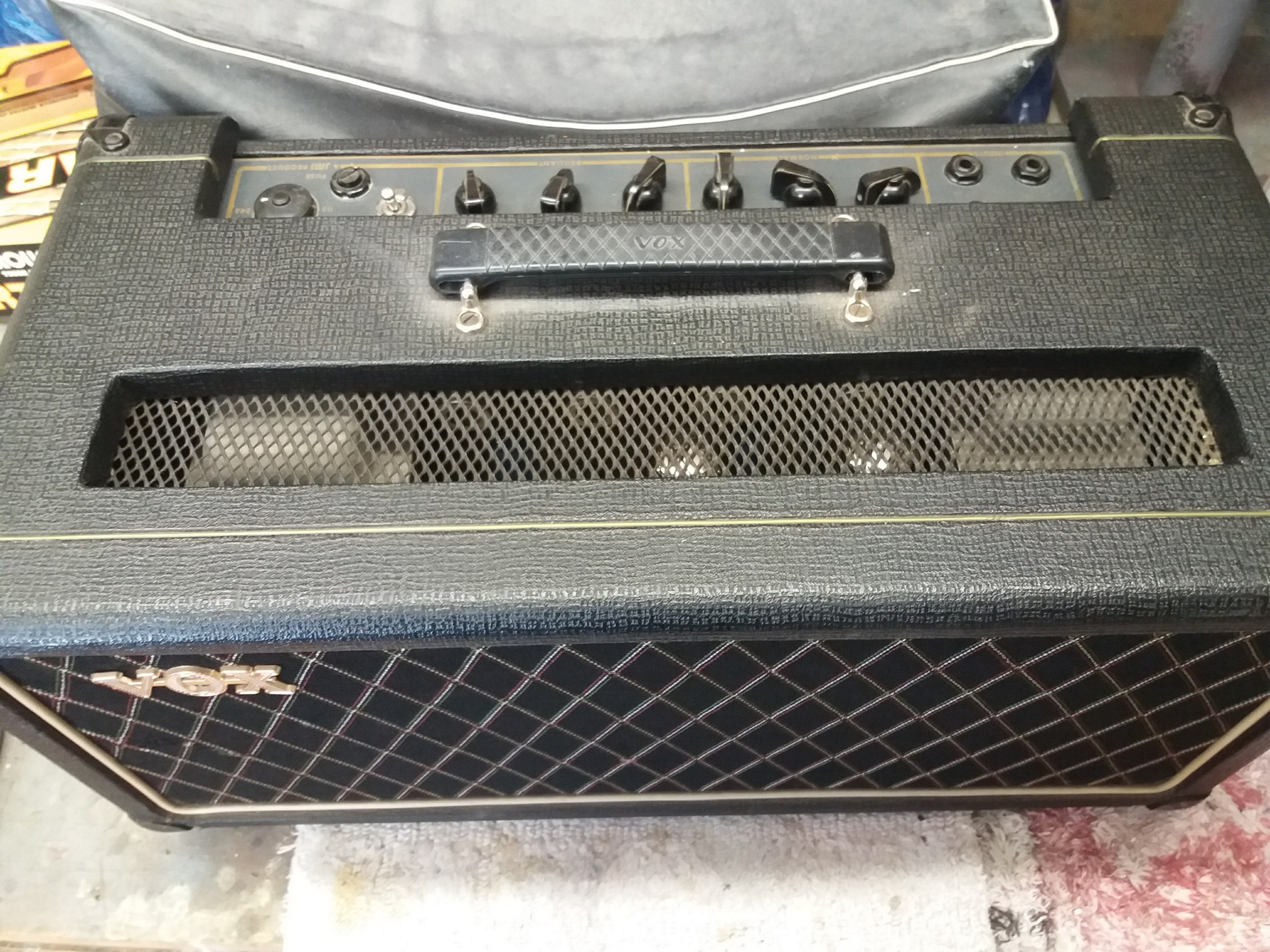

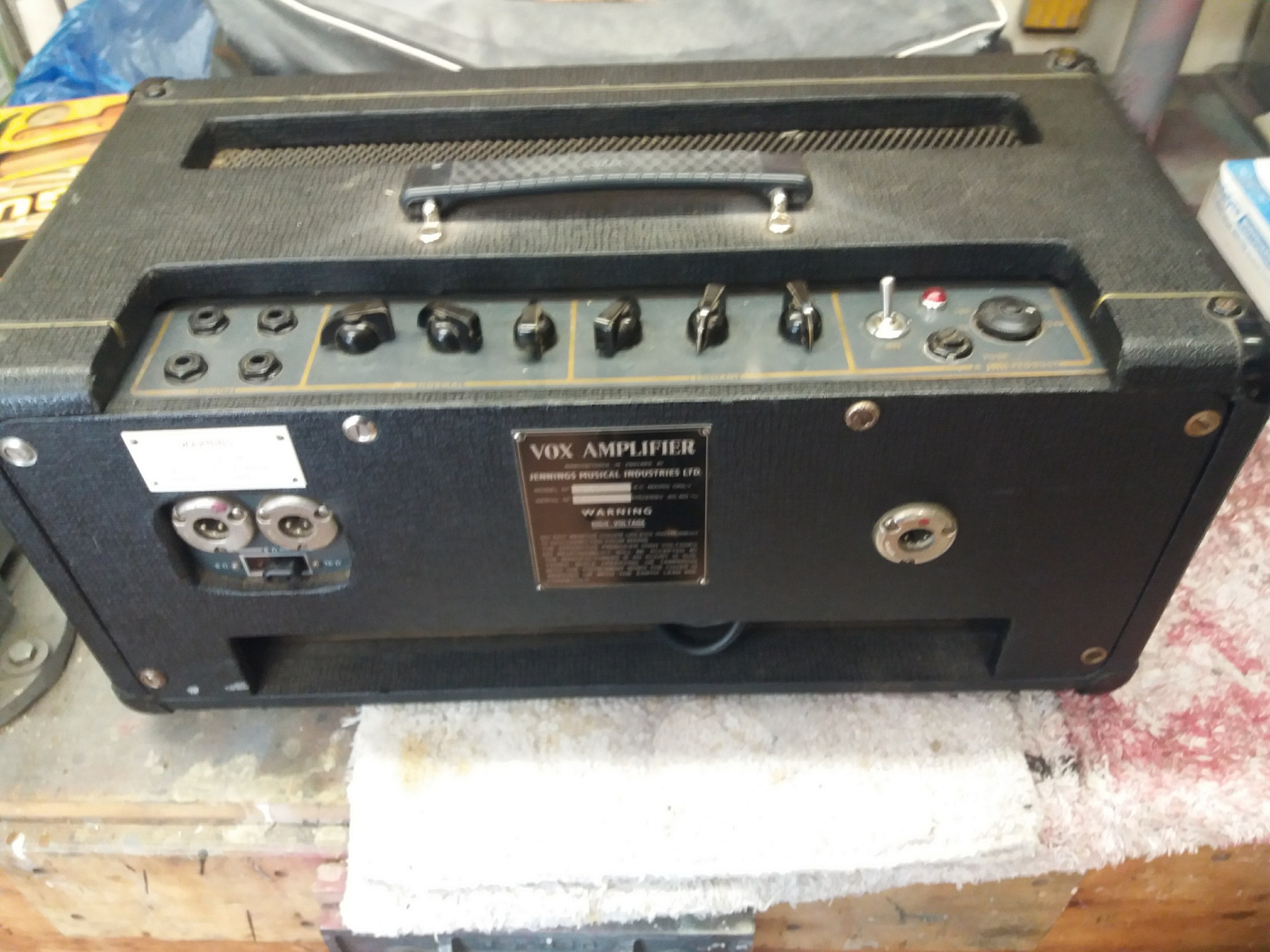
Serial number 3528 - original cover in the background.


Serial number 4878.
4th May
Below, some snippets from "International Musician and Recording World" - the AC50 at the Frankfurt Fairs of 1977 and 1978, still under the auspices of Dallas.

"International Musician, February 1977.

"International Musician, April 1978. AC50 and Foundation Bass cab to the right of picture.
Some re-adjustment of the serial number schema outlined in the entry below (11th April) is probably needed.
Since no Dallas AC50s have turned up with serial numbers beginning "7...", it seems likely that the sequence started off with "5..." in 1975 and continued into 1976. When "5999" was reached, perhaps in late 1976, the sequence was simply extended, numbers beginning with "6..." stretching into 1977 and perhaps 1978.