UPDATES
Older blog / update entries are now here.
2023
27th December
Thanks to Mark, pictures of AC50 serial number 5380, currently in the USA. Perhaps part of one of the final batches shipped by JMI to the Thomas Organ Company. Amps with serial numbers higher than the 5400s are to be found for the most part in the UK, Europe, Australia and Japan.


18th December
Just to record that "Vox Sound Equipment Limited" AC50 serial number 1026 is still extant and in good working order. These amps were normally built to JMI circuit diagram OS/163. At least two were adjusted in later decades to conform to OS/072, probably because the existence of OS/163 was unknown at the time. The page on VSEL AC50s can be found here. Thanks to Gary for the photo.

"Vox Sound Equipment Limited" AC50 serial number 1026, late 1968 / early 1969.
13th December
Some updates on the way. Below, a detail from a photo taken in 115 Dartford Road in September 1964 - AC50 Foundation Bass sets ready for shipping to the USA, the Thomas Organ model number - "V-1-14" - stamped on the cartons.

September 1964
28th September
Thanks to Keith, a shot of the spidery chassis of AC50 serial number 3709, with what looks to be a factory original black panel. Older pics of the amp can be found here. The amp presents the earliest instance encountered so far of the new black-shrouded transformers.


10th September
Thanks to Frank, pictures of AC50 serial number 3046. The latest component date codes are April 1965. One of the original yellow print Mullard ECC83s has the paint code "ME" = May 1965. Further pictures here.



AC50 serial number 3046.
1st July
Thanks to Alan, it is possible now to consolidate further the list of people who worked as wirers at Triumph in the period 1963-1965. It may be possible to add more names in due course:
Bill (?) - perhaps the chassis initialled "W" (?).
Ron Babbage - perhaps the chassis initialled "B".
Carol Bailey - perhaps the chassis initialled "B".
Mrs Cambridge - perhaps the chassis initialled "BC".
Mrs Cooper - perhaps the chassis initialled "BC".
Dave Earp - chassis initialled "DE".
Alan Griffin - chassis initialled "AG".
Mrs Hart - perhaps the chassis initialled "H".
"JSM" or "JSW" (initials on chassis of serial number 1578).
Percy - surname not known, the oldest member of the team.
Steve Rolfe - chassis initalled "SR" (serial number 1749). His main job was as tester though.
Ms Scarrow.
Roger White - chassis initialled "RW".
Work benches were in the basement of the building. Mrs Agate supplied the wirers with components. Graham Huggett, the "chassis bender", worked in another basement room further along.
Upstairs: Geoff Johnson (owner of the company); Mrs Andrews, who oversaw operations and taught new wirers how to wire up the chassis; Steve Rolfe, tester of the finished units; and Stan, who would advise the wirers when questions arose.
On some later chassis produced by Triumph there is a plain "G". This may be Sydney Goodge, remembered as being a wirer by Roger White.
30th June
Some great info recently from Alan Griffin, who worked at Triumph as a wirer from 1963 to 1965 (aged 15 to 17), assembling AC4s and AC10s initially, then AC50s and some of the PA amplifiers. Below, his initials in two AC50s from the last third of 1964. More to follow soon.

Detail of serial number 1705.

Detail of serial number 1723.
27th June
Thanks to Stuart, pictures of an AC50 bass, the amplifier assembled from elements bought at one of the Vox liquidation sales in December 1967 and September 1968. The amp section box is an original Mark 1 "thin-edge" (with added corner protectors), its serial number plate still on the underside - serial number 1068B. The back panel however is a cut-down AC30 back panel with an AC50 serial number plate - AC50 number 6737 - added from an entirely different source.
The chassis is an original Triumph-made unit, finished off by the boys who got caught selling "Vox-style" AC50s in 1969 - see this page.
The speaker cabinet is a "Vox Sound Equipment Limited" 2x15" from 1969.


A solid state rectified Vox AC50 mark 3 chassis (1965-).
22nd May
Thanks to John, pictures of AC50 mark 2 serial number 2086. Just to reiterate what was said below (entry for 6th May), the overlap between small and large box was relatively lengthy, stretching (sporadically) from serial number 1311 to 2088. It used to be said in some quarters that these small-box AC50 Mark 2s were "put-togethers", stray chassis and boxes brought together after JMI had collapsed. This seems unlikely. What are the chances of so many good boxes and chassis, all of the same date, lying around until 1968?
Further pics of serial number 2086 can be found on this page.


AC50 mark 2, serial number 2086.
17th May
Some quick shots of AC50 mark 2 serial number 1338. Although the amp had not been used for over 20 years, it works perfectly (having been brought up to power initially on a light-bulb current limiter). Further pics to follow.


13th May
A short entry for AC50 mark 2 serial number 1599 - currently on Reverb - has been added here.

12th May
Thanks to Johannes, pictures of AC50 Mark 3, serial number 2338, currently in Sweden, probably exported early on - voltage selector removed to bring the amp into conformity with local electrical legislation.


AC50 serial number 2338.
11th May
Early slider boards - large box AC50 Mark 2s.
1) The very earliest boards had two "extrusions" at front. These abutted against the baffle when the board was fully inside the box. Known from serial numbers 1338, 1354 and 1393.

Serial number 1338.
2) Rectangular boards. These rested against the upright runners for the baffle, leaving a gap between the baffle and the front edge of the board. Earliest known example, serial number 1411.

Serial number 1411.

Serial number 1578. Its board, also rectangular, makes no contract with the baffle, abutting against the upright wooden runners at front.
3) Two cut-aways at the front of the board to allow the front edge to slide past the upright runners at front and rest against the baffle. Earliest known example, serial number 1723.

Serial number 1723.
6th May (2)
Omitted from the note below, mention of the position of the white warning plaque on early large-box back panels. On the very earliest - serial numbers 1338 and 1354 - it was fixed between the the serial number plate and the cut-out for the speaker sockets; thereafter, above the speaker socket cut-out.
6th May
Some provisional remarks about the earliest large-box AC50s. Most were evidently sold in the UK and Europe, some before the big export drive to the USA got underway in early September 1964. The latest component date code present in the earliest amps is July 1964. Assembly, completion, and sale in August is perfectly conceivable.
Little is known about the pre-history of serial number 1411, but it is possible that it was part of the first consignment to arrive in the States. That the backing plate for its speaker sockets has been replaced may indicate that it originally had a vinyl-covered traffolyte panel (as serial numbers 1338, 1360, 1384, 1420, and 1499).
Shortly after the first batch of large boxes ("Type 1") had been fitted outat Dartford Road, there was a change of plan. Provision was made on the back panel (1) for the easy switching of impedances, and (2) for the hooking up of two speaker cabinets when required. The speaker sockets were mounted on a black traffolyte escutcheon panel engraved with the necessary legends and fitted with an impedance selector plug. No adjustment to the electronics of the chassis was needed. These "Type 2" boxes were in turn superceded by "Type 3", which have grey escutcheon panels.
For a short time, "Type 1" and "Type 2" boxes clearly sat together on the shelves at Dartford Road, to be taken up and fitted with chassis in no particular order. Serial number 1499 is the latest known (at present) to have a "Type 1" box. The overlap in the use of the two Types was not great.
The overlap between small and large box, on the other hand, was lengthy, stretching (sporadically) from serial number 1311 to 2088. It used to be said in some quarters that these small-box AC50 Mark 2s were "put-togethers", stray chassis and boxes brought together after JMI had collapsed. This seems unlikely. What are the chances of so many good boxes and chassis, all of the same date, lying around until 1968?
Serial number 1420 is should be said is unlikely to have been issued from factory with the two LS40s that now accompany it. The back panel of the amp originally had only one speaker socket. Two more (one jack, one XLR) were added much later.
The page on early AC50 mark 2s will be updated shortly.
5th May
Some quick shots of the back panel of serial number 1338 - the standard early (first) arrangement of elements on large box cases. Single Cannon speaker sockets, supported on a piece of traffolyte covered at front with basketweave vinyl, were the norm at this point. An identical arrangement (minus the warning plaque) can be seen on serial numbers 1360 [1384, and 1420]. Serial number 1354 has an aluminium support for its speaker sockets.


4th May (2)
Pictures coming shortly of AC50 serial number 2086, grey panel, Mark 2, late small box. Serial number 2088 is also late small box.
4th May
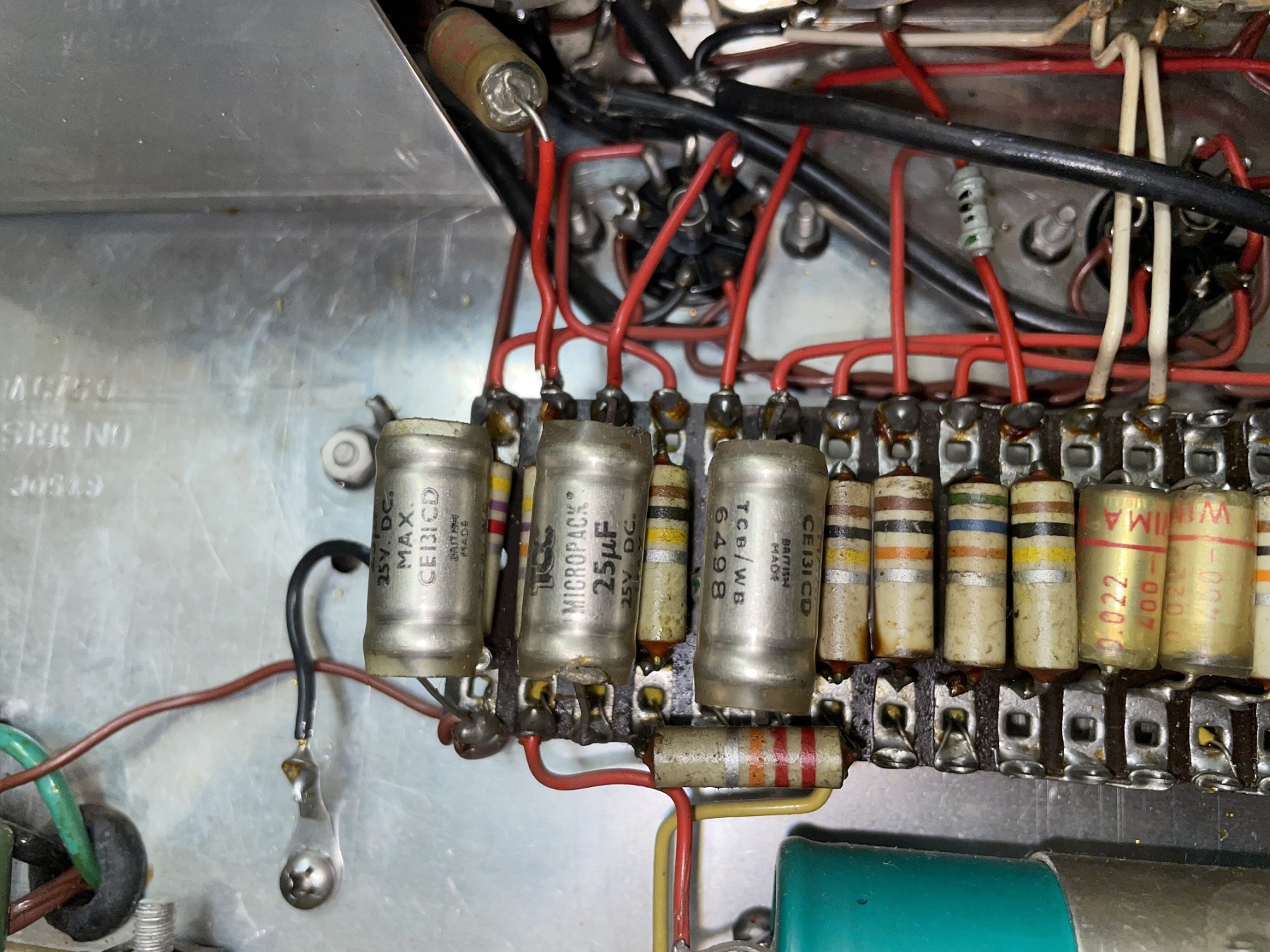
A few provisional details about serial number 1338 (pictured below). The box needs some attention. But for one replaced resistor, the chassis is fully original. Pots have date codes "BL", "DL" and "GL" (one), respectively February, April, and July 1964. Visible dates on the Hunts capacitors are "HWT" and "HIT" = 21st and 23rd weeks of '64. The Welwyn cement resistor at the speaker terminal block has "VE" = May '64. The Mullard GZ34 has the date code "B4F4" = manufactured at the Blackburn factory, 4th week of June, 1964; the yellow-print ECC83s "B4E4" = 4th week of May, 1964. The EL34s (XF2s) are later replacements. Mullard mustard capacitors: "A4N", "B4N" and B/64 = first and second quarters of '64.
On the strength of these dates, it seems likely that the amp was ready for sale at some point in August / September '64.
3rd May
Recently emerged, AC50 Mark 2 serial number 1338, probablly ready for sale in the late summer / early autumn of 1964. The amp spent its working life in the UK. More to follow shortly.


8th March
Entries for six AC50s with serial numbers in the 8000s have now been added on this page: 8149, 8170 and 8184; two unknown with "VOX AMPLIFIER" at the head of their serial number plates (low 8000s); and one with "AMPLIFIER" alone (1968).
7th March
Entries for four more AC50s with serial numbers in the 7000s now added on this page: 7073, 7406, 7572 and 7735. Serial number 7406's box has a new US-style VOX logo, the earliest (lower number) currently known.
6th March
Below, a detail of serial number 3256 showing (a) the Radiospares 0.05uf "snubber" capacitor added by JMI to amps destined for the USA in order to suppress arcing at switch on, and (b) the surgistor, a sort of load-limiting resistor similar in function to the brimistor, added under the preamp top at a Thomas Organ Service Center, perhaps the main facility in Evanston, Illinois.

Serial number 3256, detail.
Surgistors were initially recommended for AC100s alone. A service bulletin circulated by Thomas Organ in late 1965 recommended their use as a means of protecting the first of the main filter capacitors from inrush current - see this page on the Vox AC100 website. By extension, they were also fitted to numbers of AC50s that had no brimistor.
5th March
Entries created for two further AC50s: serial numbers 1708 (Mark 2, valve rectified) and 2288 (Mark 3, solid state rectified). The entry for serial number 2426, a valve rectified amp assembled at the Burndept/Vox Works in Erith, has been updated - Woden transformers and pots with September 1964 date codes.
16th February
Thanks to Mike, pictures of AC50 serial number 4367, third quarter of 1965. Further pics and info on this page.


12th February
Thanks to John, pictures of an AC50 Mark 3 chassis in an AC30 Super Twin cabinet, purchased in this form in the 1970s. Chassis number 1820, a serial number probably in the high 4000s / low 5000s. One of the pots has the date code "KM" = November 1965.


The date code "KM" is just visible on the bass pot of the Normal Channel.
11th February
The page on early Dallas-made AC50s - very late 1974 and 1975 - has now been updated, material added from the page on Dallas on the Vox AC30 website to keep the two aligned. More to come. Also ported over, the entry below:
An advert placed by Reg Clark (Tom Jenning's general sales manager in JMI days) in the music press, November 1974, signalling that Tom was now the Managing Director of Vox. The company had been bought (and saved) by Dallas in the summer of 1973, thanks to Reg's efforts behind the scenes. Reg had joined Dallas in late 1969.
In 1973, Tom was still running "Jennings Electronic Industries" (JEI), the business he had founded soon after his dismissal from JMI in 1967. But by the spring of 1974 he is said to have become extremely dissatisfied with JEI, and Reg, doubtless knowing this, cleared the way with the Dallas people for his return to Vox (first announced in July 1974).
Tom's tenure did not last long alas. In early 1975 Dallas ran into severe financial difficulties, having overspent massively on its new manufacturing facility in Shoeburyness. CBS Arbiter came to the rescue but Tom was out. He retired thereafter from the music business for good.

November 1974.
8th February
Some updates coming shortly - a little delayed as it has taken more time than expected to put the "Jennings Electronic Developments" and "Jennings Electronic Industries" sections on the Vox AC100 website into better order - first index page here and a second here.