AC50 Super Twin speaker cabinets

A detail of a picture taken at Dartford Road when the Barron Knights visited - probably in late July 1964 - to collect a set of new equipment. Thanks to Robert Valentine for the pic.A Goodmans Midax horn for a large-box AC50 speaker cabinet.
Early AC50 Super Twin speaker cabinets (July 1964 to early 1965)
Cabs were equipped with one Goodmans Midax horn and two Celestion alnico T1088s, 8 ohms apiece, wired in series for a total impedance of 15 ohms.
JMI reckoned that T1088s were good for 17 watts each. The Midax horn, rated at 25 watts (over a smaller frequency band), was essential in terms of the overall power the cab was able to handle. The two T1088s on their own were not robust enough for a 50 watt amplifier.
The earliest AC50 Super Twin set currently known is serial number 1607. Below a pair of T1088s from a correspondingly early cabinet, date code "17FJ" = 17th June 1964.


Two Celestion T1088s from an early AC50 Super Twin speaker cabinet.
Although no picture of the interior of an un-modified early cabinet has so far come to hand, the wiring schema is likely to have been similar if not identical to the one used for Vox Defiant cabinets from early 1967 - Vox Defiants also had one Midax horn and two 8ohm drivers.

Wiring schema from a Vox Defiant speaker cabinet. Two 8 ohm drivers wired in series for a total impedance of 15 ohms, the Midax horn protected from damaging lower frequences by a 2mfd capacitor.
In terms of construction, most if not all early cabinets had plywood baffles. In early 1965, corresponding with introduction of ceramic Fane 122/17s to supercede the alnico T1088s, chipboard (particle board) baffles were introduced - the two measures both brought in to decrease cost of production. Certainly where the baffles are concerned, there was a short "cross-over" period between old and new - i.e. the change did not happen overnight. The same is likely to be true for the speakers. Cabinets with chipboard baffles were made for JMI by Gla-Rev (based in Hainault, Essex). Gla-Rev may have made the earliest cabs too.
A further note on late 1964 and early 1965
Perhaps obvious really, but the earliest AC50 Super Twin speaker cabinets were finished in brown grille cloth (to match the early large box amplifier sections).
Speakers in some early instances, may have been Fanes - either 122/17s or 122/12s with "heavy-duty" labels. Such labels were also used on the 15" drivers in AC30 Expanded Frequency cabinets but not on much else. Clearly if Fanes were sometimes fitted in preference to Celestions, then the production line must have had two wiring schemas to work from - one for T1088s (8 ohms each), one for the Fanes (15 ohms each). For more on Fanes and a wiring schema, see the section below.


Pictures from many moons ago. The cab has brown grille cloth, a rectangular Cannon XLR socket (these later gave way to circular Amphenols), and just visible, a pair of Fanes with "heavy duty" labels.
Below, a pair of Fane 122/12s, 20 watts handling each rather than the 25 watts of the 122/17s.


When, in early 1965, JMI dropped the T1088s in favour of Fanes the Midax horn was retained, even though its practical value in relation to the new speakers was lessened to some degree. True, it still contributed to the cabinet's mid-range and treble response, something dear to Dick Denney (though not so much to others), but its handling power (25 watts) became somewhat redundant. Whereas a pair of alnico T1088s could only cope with 40 watts (at most), a pair of ceramic Fane 122/17s were good for around 50-60.
AC50 Super Twin speaker cabinets with Fane 122/17 speakers
Early 1965 through to 1967.
From around AC50 serial number 2600 into the 7000s. Large numbers of these went to America (distributed by Thomas Organ) and Europe. Relatively few were sold in the UK.
It is perhaps worth noting that while Fanes were the norm during this period, JMI did fit drivers made by other manufacturers from time to time - notably Goodmans and Celestion. These will be the subject of another note.
Below, a detail of the Fanes in an untouched cabinet from late 1965, along with a page from the Fane brochure of that year:

Two Fane 122/17s and Midax horn.
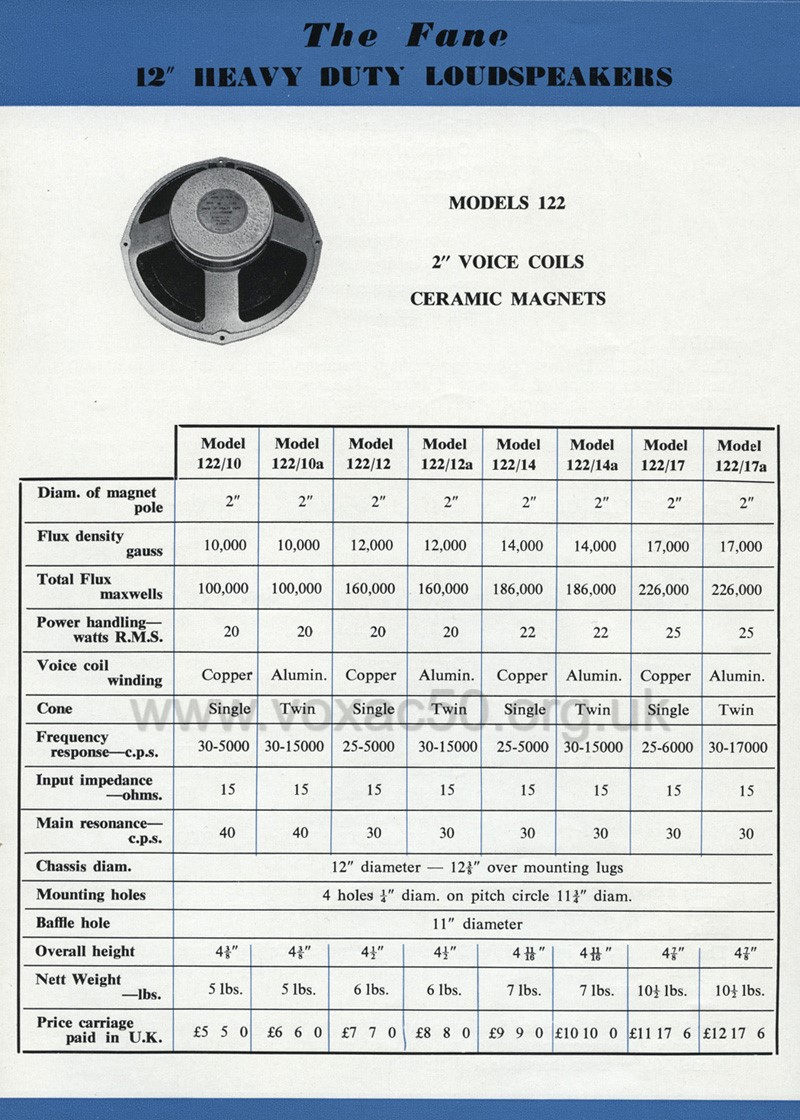
"122" drivers in the Fane catalogue of 1965. JMI used 122/10s for early Line Source 60 public address cabinets.
The wiring harnesses for these cabs were exceptionally carefully (and skilfully) made - twisted runs fixed to the baffle and underside of the top with insulated staples, virtually no slack. The two Fane 122/17s, which had an impedance of 15 ohms apiece, were wired in parallel for a total impedance of 8 ohms, the only route possible. Wiring them in series would have resulted in a total of 32 ohms. AC50 amplifier sections only had output taps for 8 and 15.

The wiring colours follow those employed by JMI, 8 ohms total at the cabinet's input socket, which was normally (from early 1965) a three-pin Amphenol XLR.
The 2mfd cross-over capacitor, an essential element (to protect the Midax horn from low frequencies), was generally fixed to the top of the cabinet. In cabs from 1966 and later, JMI sometimes positioned the capacitor on the baffle above the horn.
Now and again one sees AC50 Super Twin cabinets that have been refitted (in relatively recent years) with non-original Celestion T1088s, no change having been made to the wiring harness - the resulting impedance unsuitable of course for an AC50 amplifier. Two 8ohm speakers wired in paralllel gives a total of 4 ohms.
As mentioned yesterday, cabs with Fanes normally have chipboard (particle board) baffles, though there are occasional exceptions. "Gla-Rev", the cabinet maker contracted by JMI to produce the AC50 Super Twin enclosures, often placed its stencil - "G-R" - fairly prominently somewhere inside.

The cabinets supplied by "Gla-Rev" were, from a cosmetic standpoint, more or less complete - vinyl, grille cloth, piping, and so on, already fitted. JMI installed the handle, speakers, wiring, sockets, swivel mounts for the trolley, and serial number plate.
Cabinets initially (in the autumn of 1964) were sent by "Gla-Rev" to Dartford Road. From late 1964 to Spring 1965, they went both to Dartford Road and the new Vox Works at Erith; and from Spring '65 generally to Erith only.
1966 - non-standard type 1
A non-standard AC50 Super Twin cabinet from 1966 with Goodmans speaker sand a complex wiring scheme - complex certainly in relation to the cab with Celestions illustrated yesterday.
The driver on the left is a species of Goodmans "241", the one on the right a model and type so far unidentified (possibly an early replacement). Both have an impedance of 15 ohms. The wiring loom runs them in parallel for a total of 8 ohms. The baffle is made of plywood rather than chipboard, the 2mfd crossover mounted above the horn.
The cabinet, which turned up in Germany a few years ago, was probably exported soon after production.
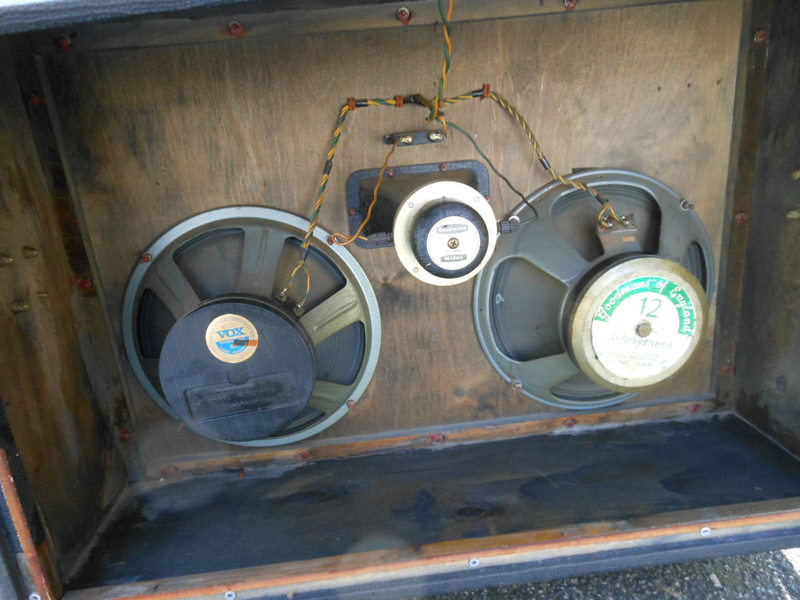
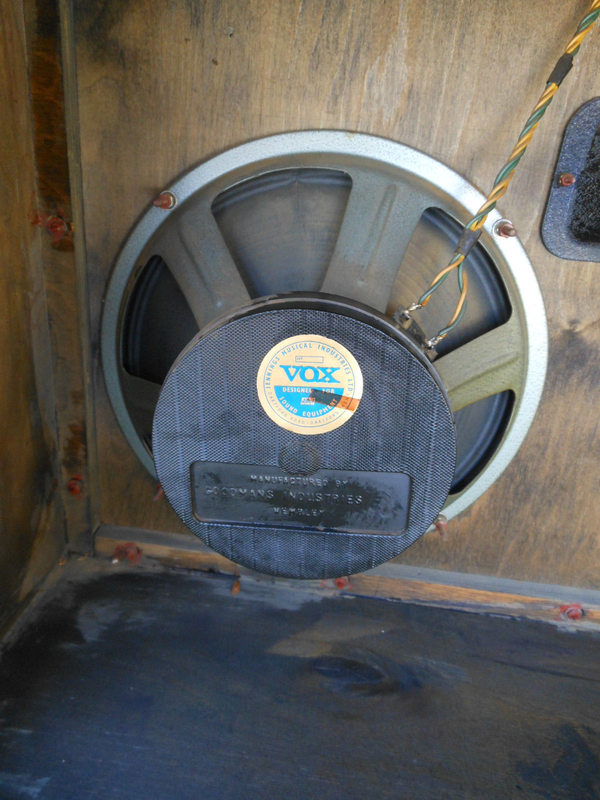
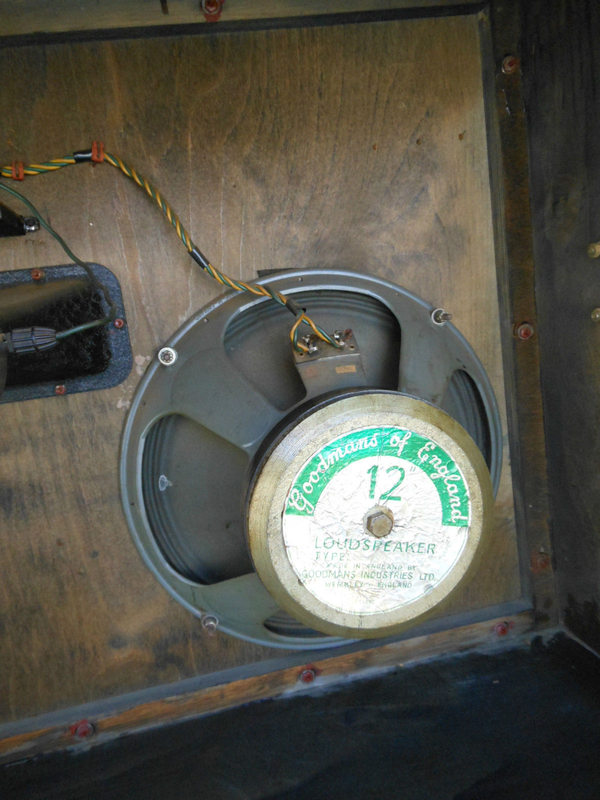

General form of the schema. The horn is represented as "straddling" the two drivers. Although at least one other permutation of wiring is possible (the loom is wound extremely tightly), this is the likeliest form.
1966 - non-standard type 2
Thanks to Phil, some shots of an AC50 Super Twin speaker cabinet from 1966 - two ceramic Celestion T1225s (15 ohms apiece) wired in parallel for a total impedance of 8 ohms, the 2mfd crossover capacitor for the Midax horn fixed to the baffle rather than the roof of the cab.
Quite how many cabs were fitted out with T1225s (instead of Fanes) is unknown at present - probably relatively few. The likelihood at any rate is that they were produced for sale in the UK and Europe, i.e. not for distribution by Thomas Organ. By early 1966 Thomas had its own range of solid-state "Vox" amplifiers, which it promoted assiduously.
Only two other cabs of this sort, or at least the remains of two others, are known at present, though it seems likely that further examples will surface, perhaps more in Europe than in the UK. AC50 Super Twins did not sell in vast numbers in the home market.

The front of the cabinet can be seen in the first picture in yesterday's entry below.


Detail of one of the T1225s. These were put into production by Celestion in early 1966, principally for JMI's 4 and 7-series amplifiers, but one finds them in AC30 Super Twin cabinets, a few AC100s, and later, in Vox Supreme cabs.

Unusually a jack socket instead of a three-pin XLR.

Colours and inter-connections follow the JMI scheme.

The cabinet's original cover.
A trolley from 1966
Thanks again to Phil, pictures of an AC50 trolley - third generation with parallel bars on top rather than a basket. Mounting hardware is of the type used on Line Source 40, AC30 and AC100 speaker cabinets - for the AC100 see this page.


Later speaker wiring
A late AC50 Super Twin speaker cabinet (crossover capacitor mounted above the horn) now containing a pair of T1088s from some other source, "Vox Sound Limited" labels, date codes "MM2" = 2nd December 1979. Unless something ingenious has been done with the wiring, perhaps out of sight, the total impedance of this cab is likely to be 4 ohms - harnesses of the type in view generally run the speakers in parallel.


Late AC50 Super Twins (1967 and early 1968)
The sense is that relatively few Super Twins cabinets were produced / sold towards the end of JMI's run. Some AC50s were evidently issued with Defiant cabinets, as below. Note the "Super Twin" runner and the fixing hardware.
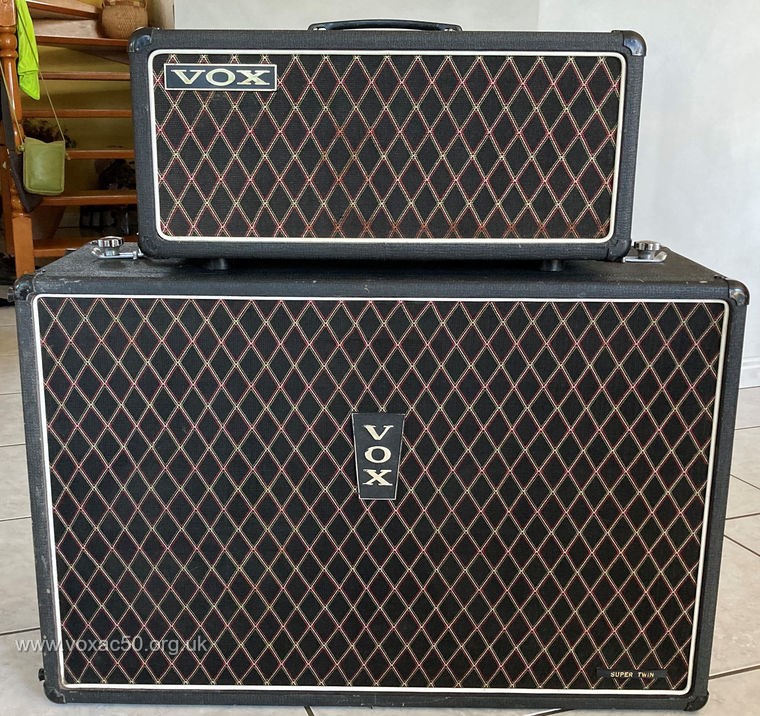
Effectively a Vox Defiant speaker cabinet with full cloth front, logo in centre, and hardware mounts on top to secure the amplifier section.

"Super Twin" runner where normally there would be "Defiant". The cab's serial number plate has no model designation, only the impedance, hand stamped - 15 ohms (two 8ohm Celestion T1297s wired in series, and Midax horn).
A second type of cabinet is the one below, standard AC50 Super Twin format, but with new-style solid state logo. The serial number plate on the back panel gives the model as "LBA54" and its impedance 15ohms (original speakers replaced some time ago). Three examples of this type of cab have come to light so far.


The plastic escutcheon for a jack sock is a later addition (note the screws).

Detail from the JMI pricelist of November 1965, the AC50 Super Twin cabinet the "LBA 54". More on the model designations to follow.
Some notes on AC50 cabinets (amplifier sections and Super Twin speaker enclosures) part-constructed in chipboard.
These were made for JMI under contract by "Gla-Rev Products Limited" (factories/works in Hainault and Dagenham, Essex).
(1) The earliest AC50 amplifier section cabinet with a chipboard baffle and back panel seems to be serial number 3124, "G-R" stencilled inside in white. Not all cabinets have such stencils, however.
(2) The latest amplifier box with a chipboard back board recorded to date is serial number 4878. From serial number 4893 through to the end of JMI's run, birch ply baffles and back boards return. No amplifier cabinet in this latter range (from around 1966 through to 1968) has a white "G-R" stencil, though it has to be said that neither do many in the 3000s either (see above).
(3) The earliest AC50 Super Twin speaker cabinet with a chipboard baffle appears to be the one accompanying AC50 serial number 2698. The cab accompanying 3051 (also with a chipboard baffle) is stamped "G-R". At some point, back panels were made of chipboard too - as they were also for certain AC100 speaker cabinets. At present, it is not possible to determine precisely when and to what extent AC50s followed suit however. The inside faces of their panels are often covered in vinyl.
Quite how many cabinets were produced by Gla-Rev before the introduction of chipboard is unknown. Production certainly looks consistent. It may be possible to determine traits/quirks of other manufacturers though (possibly to be continued...).
Foundation Bass speaker cabinets present a slightly different picture:
(4) Chipboard was evidently employed for back panels in the first quarter of 1964 (if not earlier). The cab issued with AC50 Mark 1 serial number 1015 has a solid plywood back; serial number 1034's is chipboard.
(5) Occasionally in 1964 Foundation Bass cabs have chipboard baffles - for instance, those with AC50 serial numbers 1380 and 1749 - but the norm is birch ply though to early 1968.
(6) Very few Foundation Bass enclosures issued between early 1965 and early 1968 have "G-R" stamps. Two that do are (i) one pictured with AC50 serial number 5529 (the amp has also been pictured with a different cab in older shots); and (ii) the one with 5716, this last probably from factory but given a new speaker and grille cloth in recent years.

Detail of the cab most recently pictured with AC50 serial number 5529.