UPDATES
Older blog / update entries are now here.
2020
28th December

The page on early Vox MC50s - metal-clad 50 watt public address amplifiers - has been updated and a new page started on later versions - 1966-1968.
22nd December
AC50 serial number 1354 is the earliest surviving large-box AC50 known at present. In company with a number of other early large-box AC50s, it went to Germany early on, probably from new. On its front is the name of a Hamburg band - The Hootas. The amp came back to the UK from Germany earlier this year.
Below, the band's postcard, from this page. Aside from the fact that The Hootas played at the Star Club on New Year's Day 1965 in company with a dozen or so other groups, little else is known currently of their history.


18th December
Pics of serial number 2789, solid state rectified (AC50 Mark 3), chassis assembled for Vox by Triumph in 1965 now added here. Further updates to come shortly.


AC 50 serial number 2789
8th December
A couple more AC50s with serial numbers in the 3000s: 3228, currently at Elderly Instruments; and 3464. Other amps with numbers in the 3000s can be found on this page.


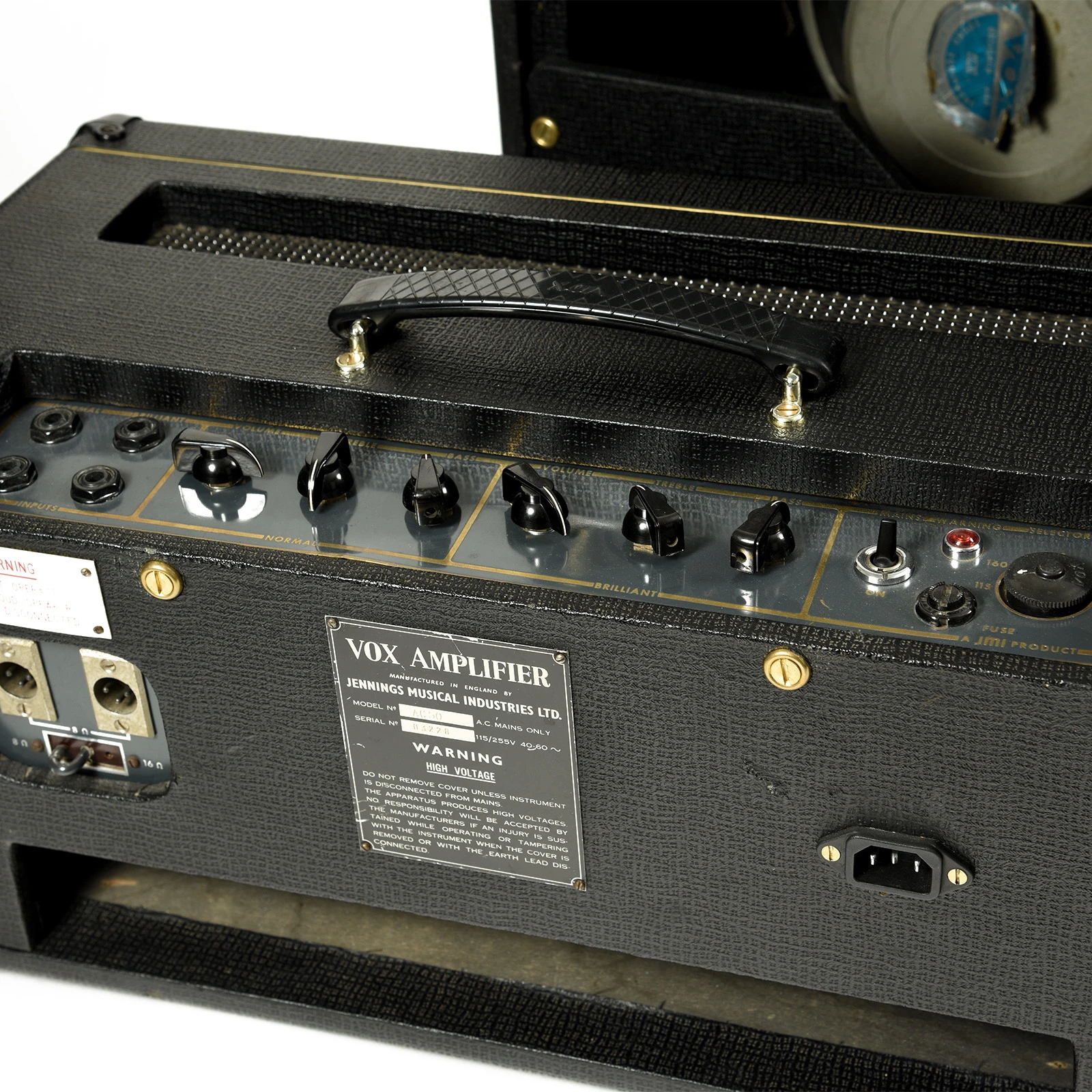
Serial number 3228.


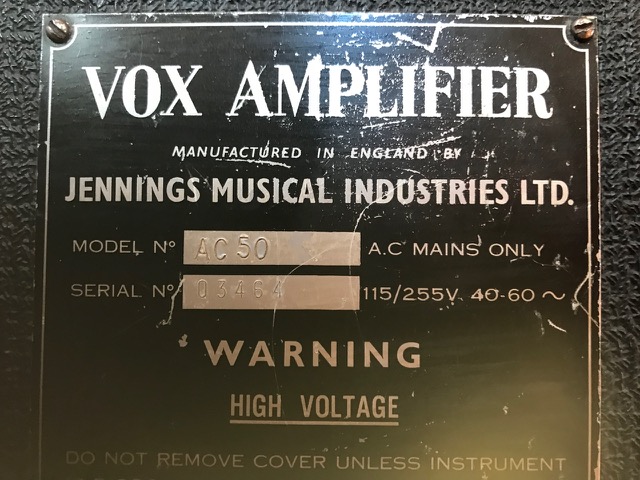
Serial number 3464.
2nd December
A further diamond input AC50, recently sold in North America - in a repro cabinet and with a repro AC100 speaker cab. Perhaps something catastrophic happened to the amp's original box. The thick-edged boxes that these amps were generally issued in (in 1964) are pretty sturdy. It is just possible of course that the original was thin-edged - a very few early diamond input amps were issued in the older less substantial form of box - but there is no way of telling at this distance.


24th November
Thanks to Mick, pictures of a diamond input AC50 mark 1 from mid 1964 - single channel, copper panel, four inputs, thick-edged box (recovered at some point in the 1970s and given a replacement large VOX logo).


23rd November
A new page has been started on the design of the the AC50 mark 1 circuit. As has already been outlined, the power section was the work of Derek Underdown, who revised a circuit he had created in the mid 1950s. The preamp, a synthesis also of existing JMI circuits, was largely the work of Dick Denney.

Detail of the preamp of AC40 mark 1 serial number 1034.
17th November
Thanks to Nick, pictures of serial number 1383, an early large box AC50 Mark 2 (valve rectified). In common with three other early amps (numbers 1354, 1367 and 1384), the speaker sockets are mounted on a plain metal plate.


13th November
The page on a group of AC50s assembled by Triumph Electronics in late 1968 with non-JMI black (painted?) control panels has been updated.
The amps are likely to have been part of batch produced by Triumph to use up remaining parts five or six months after JMI had ceased trading (late Spring 1968). The company's contract with JMI ended in late 1967 / early 1968.
Thanks to Erik of Meyer-Amps for pictures of one of the three amps currently known to exist.

There are stencilled legends for the controls, channels, inputs, and switches, but no decoration and no "JMI".
11th November
The Daily Mail "Record Star Show", Empire Pool, Wembley, 3rd April, 1966, equipment for the show provided, as ever, by Vox. Below, the Spencer Davis Group, normally seen with Marshall or Fender amps, on stage with at least one AC50 Super Twin.
Back of stage, the new UL7120 amps (small box, single handle) and speaker cabinets - the first public sighting. The Beatles did not receive their new 7120s, which were initially used only in the studio (so not seen in public), until 12th April.

The Spencer Davis Group on stage, "Record Star Show", Empire Pool, Wembley, 3rd April, 1966.


3rd November (2)
A Brimar ECC83 from 1958 marked "RTC" and "Radio and Television Components".

An English-made Brimar rebranded for RTC, England.
The French company "RTC" = RadioTechnique-Complemec, based in Suresnes and a subsiduary of Philips - had a distinctive logo applied to the rebranded valves that it commissioned from Brimar, Mullard, so on. Its valve boxes were printed in French.
3rd November
Picking up from yesterday, a little more on "Radio and TV Components", Acton. In the mid 1950s the company sold a fairly standard range of things - transformers, signal generators, capacitors, selections of new and used (guaranteed) valves. Below, the capacitors advertised in April 1955.
But the question is when this company, if "Radio and TV Components" was indeed "R.T.C.", became big enough to have components specially branded by established manufacturers. In 1955 the business premises were around the size of a local butcher's shop. See the detail from the Ordnance Survey map, below.

"Wireless World" magazine, April 1955.

Ordnance Survey sheet TQ2080SW, National Grid series, 1954/1955, 1:1250.
2nd November
It has been ventured that the red filter capacitors marked "R.T.C." used by Triumph Electronics in first generation AC50s were made by the "Reliance Telephone (Telegraph) Company". This remains a strong possibility. Reliance not only made communications equipment, but a good number of the electronic components that went into it.

A detail of the preamp of AC50 serial number 1005.
There is a possibility however - a competing one - that "R.T.C." stands for "Radio and Television Components", which was based in Acton. Much as Radio Spares, the company rebranded a good number of components produced by other companies. Its valves were mainly re-labelled Brimar, Siemens, Philips, and Mazda. It may be that "R.T.C." of Acton is indeed the supplier used by Triumph.
A separate question is how to to decipher the date codes on these red R.T.C capacitors. The codes in question are "A LM", "B LM", "M AM" and "U LM". A "new old stock" 4uf capacitor that came up on ebay (not from an AC50) has "D UB".
In view of the fact that first generation AC50s were assembled in late 1963 / early 1964, one of the letters presumably represents one of these years. But since no standard system seems to work, it seems likely that a key word, much as Hunts had, stands behind the letters.
1st November
There are six AC50s on kleinanzeigen at the moment - serial numbers 5626 and 6722, mentioned earlier, and serial numbers 2812, 2790 (with Foundation Bass speaker cabinet), 5533 and 8221 (with Foundation Bass cab).
30th October
Thanks to Phil, pictures of an AC50 Super Twin speaker cabinet and its original cover (along with an AC100 amplifier section cabinet with its cover). Not too many AC50 speaker covers around these days.


29th October
Thanks to Scott, pictures of a four-input small-box AC50, probably made in the second quarter of 1964, that turned up recently.


28th October
"The Fortunes" on Dutch TV, March 1966, with three AC50s. The nearest - one of the two Super Twins - has a trolley with a rectangular "basket" on top for the amp to sit in, a format used only briefly by JMI in the late autumn of 1964. Later, trolleys were made with parallel bars on top.

25th October
Below, details from the JMI catalogue and pricelist printed to accompany the Vox presence at the Frankfurt Music Fair in March 1968 - the catalogue is dated March 1968. The Fair was the last trade show of any sort that JMI attended. JMI ceased trading soon after, to be replaced in the late summer of 1968 by "Vox Sound Equipment Limited" (VSEL).
Note that the amplifier section of the AC50 Foundation Bass has a new-style American logo.


21st October
A panel from the flyer released by JMI in August 1965 advertising various items to be shown a the "British Musical Instrument Industries" Fair later in the month.
The amplifier section and speaker cabinet take the general form of an AC50, but they are in fact something different - a sort of first attempt at the appearance of the UL range, which eventually came to market in late Spring 1966.
Note the metal strips - similar to those used by Fender - on the solid top of the amplifier box. There is no top-mounted control panel. Note too that the amp is fixed to the speaker cabinet using a Fender / Vox Domino bracket with knurled screw.

17th October
Serial number 4875 now here. A nice chassis and back panel recently sold in Germany. Potentiometers have the date code "JM" = October 1965, so the amp is likely to have been produced in very late '65, or perhaps early 1966.
Serial number 4875 - currently in Germany


16th October
Pics of serial number 8196, early 1968, now added here.


15th October
Serial number 4512 now added. Potentiometer date codes are "IM" = September 1965. Thanks to Jan for the pictures.


10th October
Serial number 4893, late 1965, now added here. One of the Hunts preamp filter caps has the date code "IDS" = 38th week 1965.


9th October (2)
Recently sold in Germany, serial number 5680 - lowest serial number so far with a chassis with the new black transformers. But the chassis number, which would probably be more meaningful in this instance, is unknown. Further pictures of the exterior are here.


9th October
The German market was a good one for Vox in the second half of the 1960s. AC50s were extremely popular. Mark 3s regularly come up for sale. The two below are (among others) current at the moment: serial numbers 5626 and 6722.


Serial number 5626. Currently (October 2020) here. Chassis number 2237. The pots have codes "CN" and "DN" = March and April 1966.


Serial number 6722, late 1966. Currently (October 2020) here.