UPDATES
2019
June to November
29th November
AC50 mark 3, part 6: fuseholder, control knobs, and on/off switch. Just to add that the company that did much electro-plating work for Jennings in the second half of the 1960s and perhaps before was "Holmes Plating" in Blackheath.

FUSEHOLDER and CONTROL KNOB: Belling Lee and Bulgin.

CONTROL KNOB: Detail of Bulgin name. Unmarked chickenhead knobs were also used, probably from Radiospares.

ON/OFF SWITCH: Arrow "black bat" - the one above is from a different amp though.
28th November
AC50 mark 3, part 5: input jacks; preamp fittings. Fuseholder, control knobs, and on/off switch still to come.
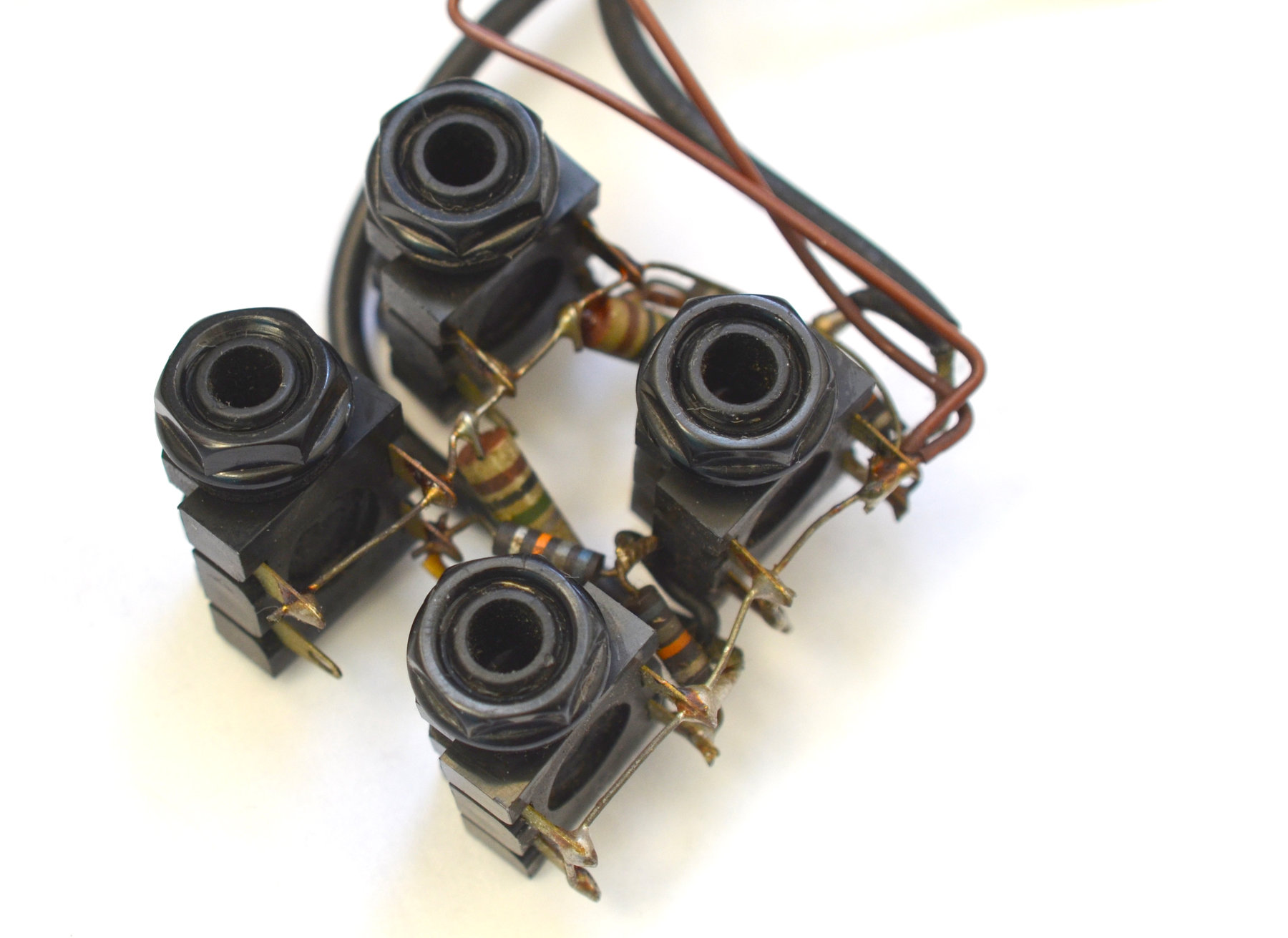
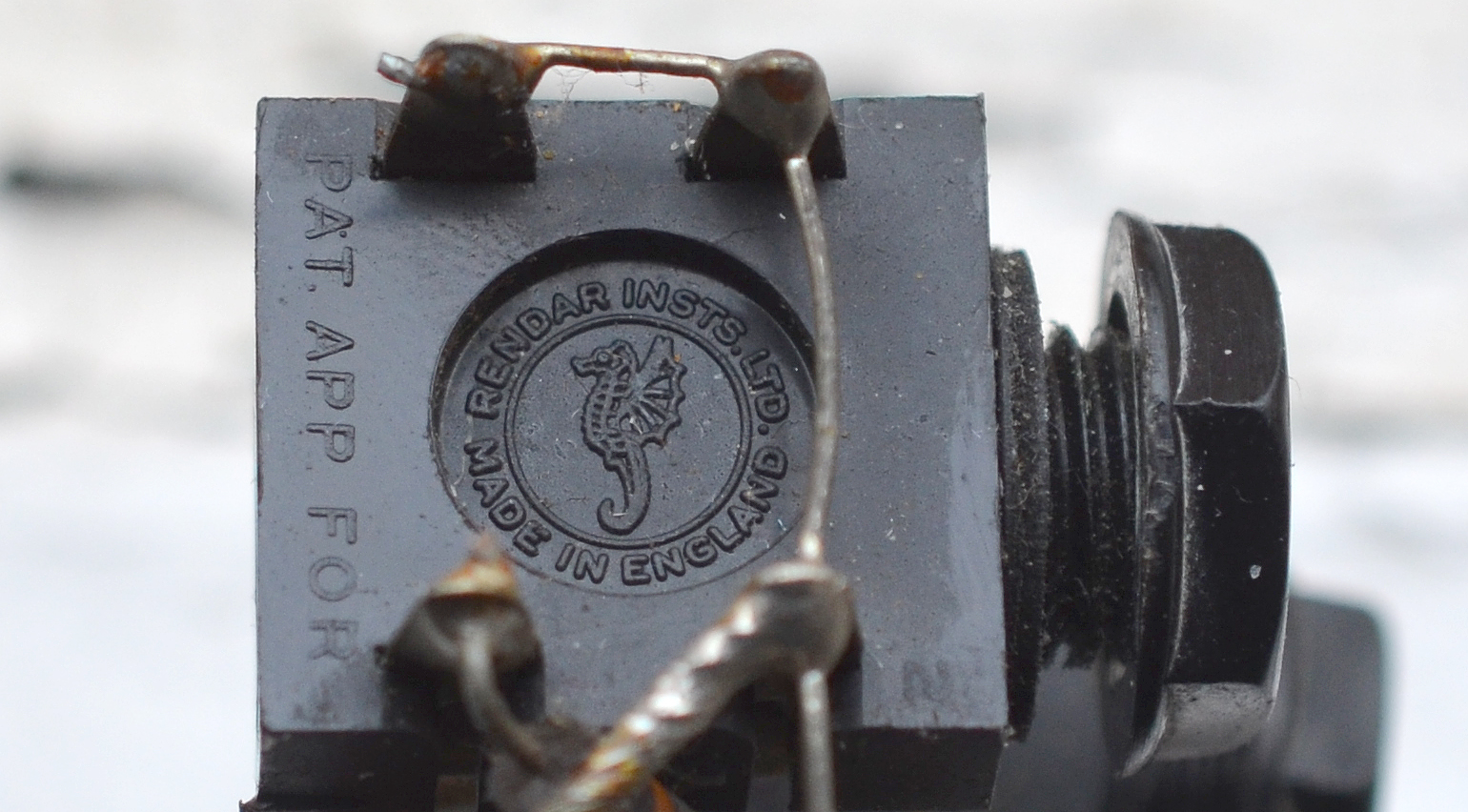
INPUT JACKS: Rendar Instruments Ltd.

TAGBOARD: Radiospares, miniature "group panel".
CAPACITOR CLAMPS: unknown.
RUBBER GROMMETS: marked P.B.C. G9, maker unknown.
RESISTORS: Erie 1/2W, type 8.
25uf CATHODE BYPASS CAPACITORS: Gold-coloured TCC (Telegraph Condenser Company) Micropack.
COUPLING AND TONE CAPACITORS: WIMA Durolit.
27th November
AC50 mark 3, part 4: the underchassis tagboard; internal fuseholder; voltage selector; and output terminal block. Tomorrow, the remaining fittings.

TAGBOARD: Radiospares, standard "group panel". Miniature "group panel" was used for the preamp.
VALVE BASES: Macmurdo, as in preamp.
POTENTIOMETERS: Egen Electric Ltd. See this page on the Vox AC100 website
RESISTORS: Erie 1/2W, type 8.

TERMINAL BLOCK (to speakers): Radiospares. Also referred to as "Barrier Strip".
VOLTAGE SELECTOR: specially made for Vox, manufacturer unknown.


INTERNAL FUSEHOLDER: Bulgin F27/3. Vox also used fuses supplied by Bulgin.

INDICATOR LAMP: Bulgin D180.
26th November
AC50 mark 3 metalwork, part 3: the aluminium preamp shell.

ALUMINIUM: 1/16" thick, anodised.
DIMENSIONS OF UPRIGHT: 16 1/2" wide, 5" high.
DEPTH OF TOP (for control panel): 2 7/8".
LIP: 9/16".
PREAMP VALVE HOLES: 3/4" diam.
SLOTS (for securing the aluminium to the transformer shrouds): 3/16" wide (for 2BA bolts).
PASS-THROUGH HOLES: 1/2" diam.
OTHER HOLES: 1/8" diam. (for 4BA).
CAGE NUT HOLES: 3/8" square.

To show the profile of the edge.
25th November (2)
AC50 mark 3 metalwork, part 2: the control panel.

Anodised aluminium with etched brass embossing. DIMENSIONS: 16 7/16" x 2 15/16".

INPUT JACK HOLES: 5/16" diam. HOLES FOR POTENTIOMETERS: 3/8" diam.

MAINS SWITCH HOLE: 1/2" diam. BULGIN LAMP: 3/8" diam. BELLING LEE fuseholder: 5/8" diam. with notch. VOLTAGE SELECTOR: 1 1/16" diam.
25th November
The first of a series of posts on the metalwork of the AC50 mark 3 chassis. Below, the plinth.

STEEL: 1/16" thick, passivated.
DIMENSIONS: 16 1/2" x 6 3/8".
OT cutout: 2 1/8" x 2 3/4".
OT corner holes, centre to centre (for 2BA screws): 2 1/2" x 3 1/8", diam. 3/16".
MAINS TR. cutout: 2 5/16" x 3 1/8".
MAINS TR., corner holes, centre to centre(for 2BA screws): 3" x 3 3/4", diam. 3/16".
VALVE BASE HOLES: 1 1/16" diam.
BIAS POT HOLES: 5/16" diam.
CAGE NUT HOLES: 3/8" x 3/8".
HOLES for smaller screws (4BA): 1/8 diam".

UNDERSIDE OF CENTRE TO FOOT: 1 1/8".
WIDTH OF CENTRE: 5 5/16", including width of metal, at the top; 5 3/16" at the bottom - the sides are angled in slightly.
SIDE FLANGES: 9/16".


The upright of the preamp attaches to the side of the plinth above. The holes are for wiring pass-through as well as screws.
WIRING HOLES: 3/4" diam., to accept rubber grommets on preamp upright
SMALLER PAIRED HOLES (for capacitor clamp screws): 5/16" diam.
21st November
Below, a good clean image of the AC50 used by Vox for publicity purposes in the last third of 1964 - from the American "Million Dollar Sound" catalogue of late '64 / early '65. The accompanying text though, as in material circulated in England, describes the new large-box AC50 and speaker cabinet.
Note the small spur (one of two) on the top bar of the trolley. These also figure on the trolleys made for The Beatles' early AC50s - see the detail below. They are absent, however, from repro trolleys.


Detail from a pic. from the photo session at Abbey Road with Jimmy Nicol shortly before the European tour of June 1964.
20th November
An advert in "Music Echo", 4th December, 1965, incongruously showing a small box thick-edged AC50 (presumably with diamond inputs) and AC30 cab - a photo that dates back to late 1964 - see this page. At the head of the new Vox items at left, a metal-clad PA100 (three microphone inputs, one music) - not a PA50 as stated earlier - said to be capable of producing up to 130 watts. Its dimensions are 14" x 7.5" x 14".

Crossguns Bridge is a short distance north of Dublin.
14th November
"New Musical Express" magazine, 22nd May, 1964 - The Searchers on stage with two AC30s and an early AC50 Foundation Bass set - again AC50 rather than AC100. The event was the 3rd Annual Beat Festival held at Botwell House (now demolished) in Hayes, Middlesex.
In the background, three early Marshall JTM45s and cabs. Jim Marshall's shop was not far from the venue.


Botwell House in 1910. Picture from this page.
13th November
A detail from a picture of the "The Ingoes", forerunners of "Blossom Toes", at the Crawdaddy Club, Croydon, December 1964, with an early AC50 (or perhaps AC100) Foundation Bass set. Although the angle of view is somewhat oblique, the amplifier's box certainly looks to be thin-edged. The original pic is here.

9th November
"Melody Maker" magazine, 14th March, 1964 - an even earlier advert for the AC50 Foundation Bass, now registered on this page.
Most early single channel AC50s (two and four input) were sold as bass units.

8th November (2)
CHALK MARKS
1) Numbers were regularly chalked inside boxes and on the inner face of back panels as a means of ensuring that box and panel could always be matched back up if separated. In the days of hand finishing, screw holes varied in position from box to box.
2) Initials or signatures: often the person who finished the box off (ie. made the case ready for sale).
8th November
A provisional note on "Gla-Rev Products Limited", the company that made vast numbers of wooden boxes for Jennings Musical Industries (for amplifiers and speaker cabinets) from 1965.
The company's mark "G-R" is normally stencilled in white.

The stencil on the bottom of the case. AC50 serial number 2307.
Many boxes however are not marked, however, except in chalk (see the entry above).
Some details, albeit sparse for the time being, about "Gla-Rev". The company seems to have been formed in the early 1950s, its name an amalgam of those of its founders: Henry Glass and Revel. Glass also traded under his own name, moving his business operations to Ipswich in the early 1970s. Glass made cabinets for Hiwatt, Sound City, and many others.
From early days "Gla-Rev" produced a wide variety of goods - leather luggage, plastic and vulcanised fibre containers, wooden cabinets and boxes, and so on - "enclosures" of all sorts. The factory was first on Selinas Road in Dagenham (East London), then from around 1960 on Fowler Road, Hainault (Essex). Glass was evidently the driving force behind the woodworking side of things.
TAYLOR-MADE WOODWARE
As noted in the entry below, "Taylor-Made Woodware" stickers appear on the slider boards of at least two AC50s. Both are currently in the States, one exported there in 1965 by JMI. The company that made the boards is likely, on balance, to have been American - the boards being replacements, stocked by Thomas Organ. The Thomas Organ part number for replacement boards is: 09-5428-0:

Detail from the Thomas Organ parts list for the AC50. The sheets are available on this page.
Ignore the suggestion below that the company was based in Kent.
6th November (3)
A short (initial) note on the slider boards in AC50 boxes. In 1965 (and possibly before), the boards were made by a company, presumably in Kent, with "Taylor" in its name - perhaps "Taylor Limited", "Taylor Furniture Company" or "Taylor Woodware Limited" - something along those lines.
By serial number 3124, if not before, the large boxes for the AC50 were made by the Gla-Rev company (white stamp "G-R" inside).

Slider board in serial number 3619

Slider board in serial number 4424. The date code on the pots "IM" = September '65.
6th November (2)
Currently on ebay.uk: AC50 serial number 8252 from 1968. As is normal with amps at this date, the warning plaque is white and the serial number plate has "AMPLIFIER" at its head rather than "VOX AMPLIFIER".


6th November
Sold in the USA a little while ago. A number probably in the 4000s - three-line serial number plate (moved to cover the hole left when the the Amphenol mains socket was removed), white plaque, Amphenol speaker sockets removed.
AC50 serial number 4651 certainly, and number 4922 probably, also have white plaques and three-line plates.


5th November (2)
Nine more: serial numbers 2854, 3434, 4232, 4344, 4533, 5784, 7272, 7557, and 8044.
5th November
Recently added, serial number 1966, a large box AC50 mark 2, late 1964. The norm - note that these norms where Vox is concerned are seldom utterly infallible rules - is that from around serial number 1750 to 2250 or so, the model "AC50" is hand-stamped on the serial number plate, and the serial number machine-stamped. Number 1966, along with 2088 and 3385 are exceptions: both model and number are hand-stamped.


4th November
Further pics of serial number 1384, an early large-box AC50 mark 2 (valve rectified, link voltage selector), now on this page.

21st October
A series of updates coming soon. Recently come to light, serial number 8234, produced as JMI was winding down, probably early summer 1968. 8297 is the highest serial number known at present.
28th September (2)
Below, a page from Thomas Organ Vox Teen Beat magazine, vol. 1, issue 3, from mid 1966. Still the AC50 Foundation Bass as the "Westminster".


28th September
A page of photos on the early AC50 mark 2 signalled in the entry immediately below (17th Sept.).
17th September
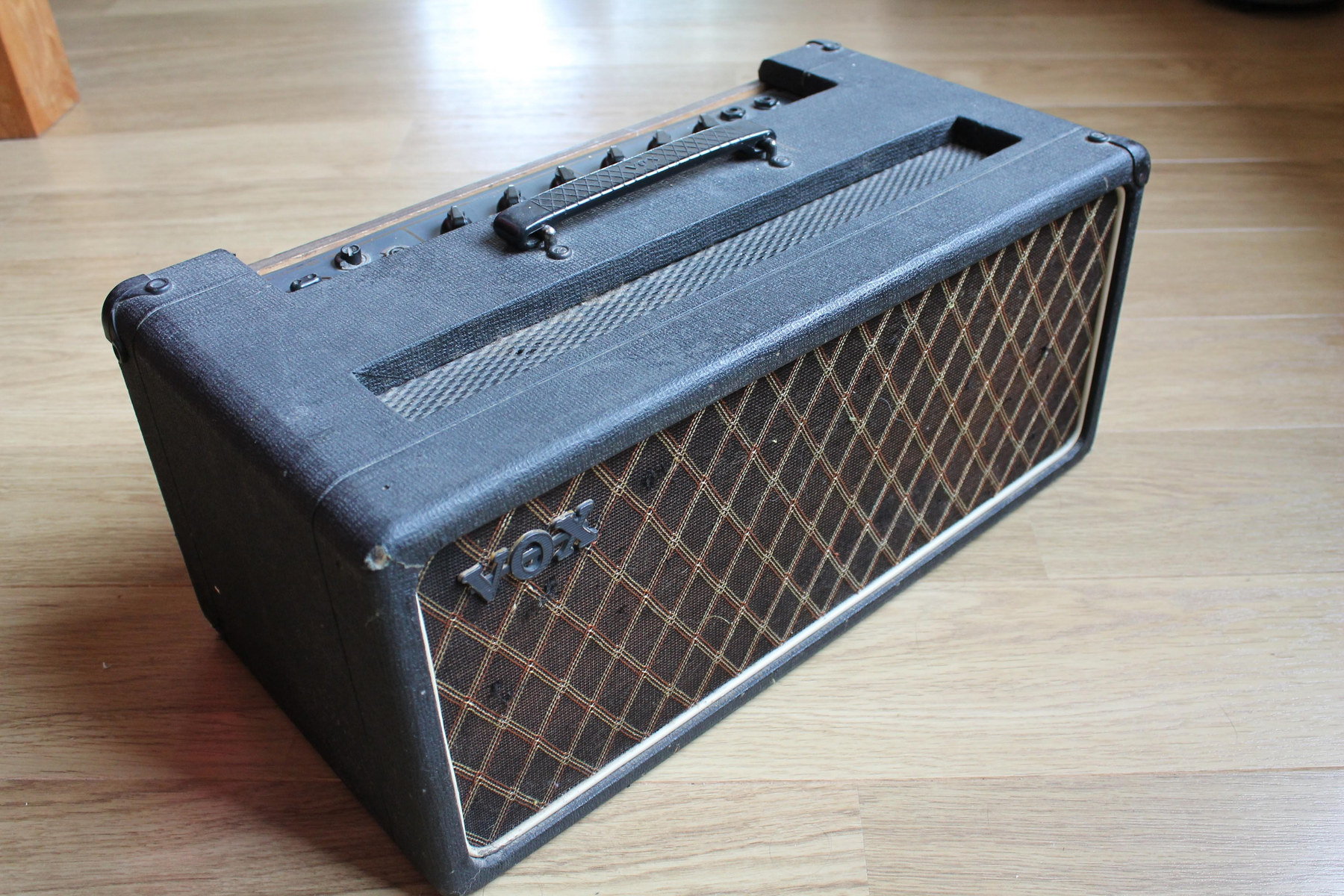
Thanks to Alan, pictures of an early large box AC50 with link voltage selector - the serial number probably in the 1500s or 1600s (the plate is missing). Further pics will be added on the relevant page later this week.
DATE CODES (of original components): - the mustard capacitors in the preamp have various codes - "A4N", "B4N" and "C4N", which mean first, second and third quarters of 1964 respectively.
The long blue Hunts capacitor in the third picture below has a code just peeping out - "HNT", which is 27th week of 1964 (last week of June). At least four of the potentiometers have the date "GL" = July 1964; and one has "HL" = August 1964.
ASSEMBLY: - by Triumph Electronics early in the last third of 1964.


25th August
Three late JMI AC50s - AC50 Mark IVs (see the schematic below, entry for 21st June) - sold by Servaas Muziekhandel, The Hague. The upper picture is of serial number 8200, the other two serial numbers unknown:


For pictures of the original shop, see this page.

"Beat Instrumental" magazine, February 1969. By this time, i.e. during the "Vox Sound Equipment Limited" period, the main Vox distributor in Holland was Fa. Timmermans, muziekinstrumenten, Bilderdijkstraat 136.
24th August (2)
Serial number 4249 now registered here. Sold in the 1960s by Musikhaus Hummel of Frankfurt.
24th August
Further pictures of AC50 serial number 5533 added here - various component date codes in view.

17th August (3)
Four further AC50s now added: - 5546, 5815, high 7000s, and 8215.
17th August (2)
Three more amps with serial numbers in the 6000s added: - 6355, 6808, and one number unknown (with double-pin corner protectors).
17th August
A strange one sold in the UK earlier this year. An AC50 with an unusual machine-stamped serial number - apparently 11113 - in company with a "Vox Sound Equipment Limited" T100 cabinet (1968-1970). 2 x 15" cabs were only called "T100" from late 1967/1968.
A small point, but if you find it said that Paul McCartney had a "T100" or that JMI supplied something called a "T100" before 1967, then make a mental note: anachronism at work.


Serial number plate. Although the number is a little difficult to read, it is clearly 111xx, probably 11113.

Jennings Musical Industries retail pricelist, April 1967. The cabinet - item 055 - is called the "AC100 Bass Cabinet (2 x 15")".
13th August
Updates on around a dozen amps coming soon. Below, AC50 serial no. 6685 - thanks to Arnaud.


12th August
A grab from a video of the Dave Clark 5 performing "Looking In", an AC50 Foundation Bass at right. Thanks to Ihor for the pic:

21st June
Thanks to Jeremy, a copy of the AC50 mark IV schematic - OS163. Amps with serial numbers from the mid 7000s and later were built according to this circuit, the principal differences in the preamp centring on V1 - adjustments for an ECC83 instead of an ECC82 (though it was always possible to use an ECC83 as V1 in a Mark 3 amp) - and a new topology for V3.

Vox AC50 Mark 4 schematic. Click for a larger image, as ever.


Above, details of the preamp of a late JMI AC50 built to this scheme.
The change to the Mark 4 schematic comes in at around serial number 7400, but some care is needed as a number of amps with higher numbers are still Mark 3s.

As the panel above shows, the AC50 mark 4 circuit was drawn up in April 1967. Various adjustments were made in July and August, and a final change in October 1969 in the time of "Vox Sound Equipment Limited" - see the VSEL AC50s on this page.
Evidently "Vox Sound Limited", the third incarnation of Vox (mid 1970 - late 1973), simply copied OS/163 from a sheet drawn up by "Vox Sound Equipment Limited" (mid 1968 to early 1970). The plan presumably must have been to revive both the AC50 and the AC100. The latter became (with some changes) the VSL V100. However, for whatever reason, nothing further was done on the former: VSL did not build or issue any AC50s.

VSL were still in Erith when this sheet was drawn up - so summer of 1971.